THREE TEMPLES · DISTINCT WITNESSES · A CLOSER LOOK
Study the measurements.
Explore Solomon’s Temple, the Second Temple, and Ezekiel’s visionary Temple, including a future-Temple reading. Turn a study model, open its rooms, and follow a dimension to its source.
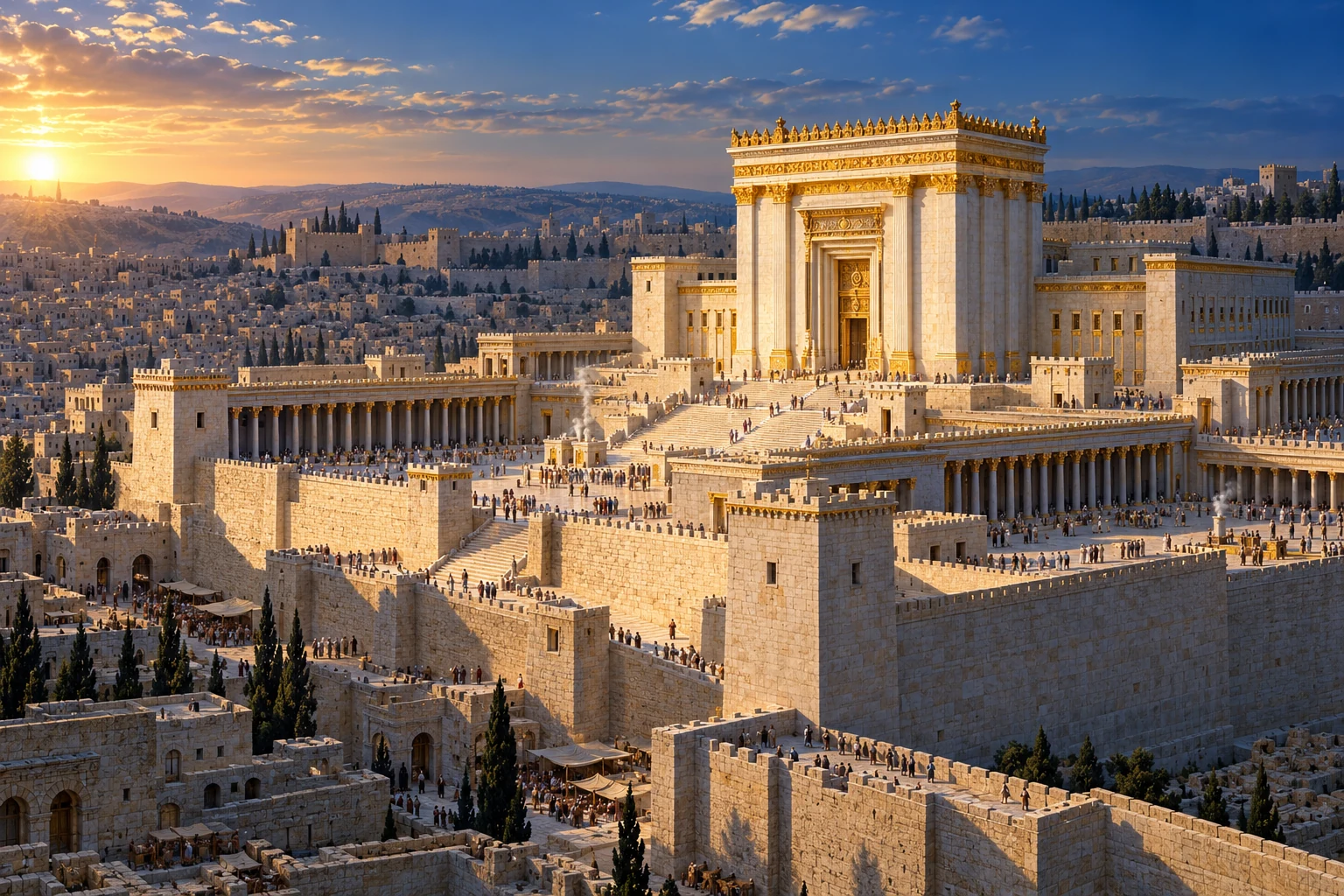
Built Temple · late Second Temple phase
Second Temple · Herodian phase
Follow Josephus into the late Second Temple sanctuary. Herod enlarged the existing Second Temple; this is not a third Temple. Earlier rebuilding belongs to the same Temple history.
Listen to the editorial study
AI-generated narration reads the editorial explanation. Cited texts retain their own wording and editions.
English name-reading helps
These are English reading choices, not claims to reconstruct ancient pronunciation: Melchizedek (mel-KIZ-uh-dek), Ezekiel (ih-ZEE-kee-uhl), Mahaway (muh-HAH-way), Qumran (KOOM-rahn), Zadok (ZAY-dok), Jubilees (JOO-bih-leez), Jasher (JASH-er). Device voices may vary.
Drag horizontally to turn, or use the buttons and keyboard. The model stays still until you move it.
Selected sanctuary spaces and facade dimensions from Josephus. Facade depth, side chambers, roof construction and the surrounding courts are not fully modeled. Mishnah Middot is an additional architectural witness; its measurements are not silently merged with Josephus.
Chronology, sources & reconstruction choices
The Second Temple was rebuilt after the exile (Ezra 3–6). Herod’s rebuilding is a later phase; the Roman destruction belongs to AD 70 (Josephus, Jewish War 6).
Ancient cubits vary. The optional conversions use illustrative values of 0.45 m per ordinary cubit and 0.525 m per long cubit; they do not determine the ancient standard. Compare textual cubits first. A projected dimension cannot be measured accurately from perspective pixels.
3D geometry expresses selected measurements. Decorative details, exact archaeological placement, complete engineering structure and every room are not reconstructed. A future architectural refinement can extend this same source-linked model.
Second Temple phases: Ezra 3–6 · early rebuilding ↗ · Josephus · late Temple ↗ · Mishnah Middot · separate witness ↗
Compare all three · measurements and witnesses
Each entry keeps its source. Equal numbers do not make the buildings identical; Ezekiel uses the long cubit.
First Temple · Solomon
| Feature | Measurement | Source & qualification |
|---|---|---|
| The house | 60 × 20 × 30 cubits | 1 Kings 6:2 ↗ The model uses this envelope; thin display walls do not establish ancient wall thickness. |
| The main hall | 40 cubits long; 20 cubits wide | 1 Kings 6:16–17 ↗ The colored floor separates the rooms. Door construction and floor levels are simplified. |
| The inner sanctuary | 20 × 20 × 20 cubits | 1 Kings 6:19–20 ↗ The cutaway opens a room normally enclosed. This simplified diagram omits the Ark and great cherubim. Their textual dimensions and the artistic choices in their forms are distinguished in the detailed study. |
| The entrance porch | 20 cubits across × 10 cubits deep | 1 Kings 6:3; 2 Chronicles 3:4 ↗ Only the footprint is measured here; the model does not silently replace 120 with another height. |
| Jachin and Boaz | 18 cubits high; 12 cubits around; capitals 5 cubits | 1 Kings 7:15–22 ↗ Round shafts approximate a twelve-cubit circumference. Capital ornament and placement are simplified. |
| The bronze sea | 10 cubits across × 5 cubits high | 1 Kings 7:23–26, 39 ↗ A cylindrical marker shows the basin’s named span and height. Its supports and curved profile are not reconstructed. |
| The bronze altar | 20 × 20 × 10 cubits | 2 Chronicles 4:1 ↗ Its position in front of the house is a diagrammatic arrangement; the model does not supply stairs, horns or construction details. |
Second Temple · Herodian phase
| Feature | Measurement | Source & qualification |
|---|---|---|
| The monumental front | 100 cubits wide × 100 cubits high | Josephus, Jewish War 5.5.4 ↗ The facade is shown as a thin dimensional frame. Its four-cubit display depth is schematic, not a quoted ancient measurement. |
| The first opening | 70 cubits high × 25 cubits wide | Josephus, Jewish War 5.5.4 ↗ The opening is cut through the dimensional front frame; ornamental details are omitted. |
| The inner house | 60 cubits long × 20 wide × 60 high | Josephus, Jewish War 5.5.5 ↗ The interior volume is shown separately from the hundred-cubit front. This is not the total external building length. |
| The main room | 40 cubits long | Josephus, Jewish War 5.5.5 ↗ The colored floor marks the room in this dimensional diagram. The optional 3D prototype includes interpretive furnishings; their forms, sizes and positions are not supplied by this room measurement. |
| The Holy of Holies | 20 cubits long | Josephus, Jewish War 5.5.5 ↗ This model places no Ark in the late Second Temple room. The text’s empty room is preserved. |
| Before Herod: rebuilding after exile | A decree is not an as-built survey | Ezra 3:8–13; 6:3–5, 14–16 ↗ No detailed early Second Temple model is fabricated from the Herodian description. Read the earlier history as its own phase. |
| The exterior altar · dimensional study | 50 × 50 × 15 cubits · length, width, height | Josephus, Jewish War 5.5.6 ↗ This native diagram has no exterior altar feature. The optional detached study shows a dimensional envelope, not a completed altar design. Profile, horns, ramp and exact placement remain unresolved; no courtyard layout or measured house offset is supplied. These dimensions do not apply to the interior incense altar. |
Ezekiel’s visionary Temple · future-Temple reading
| Feature | Measurement | Source & qualification |
|---|---|---|
| The measuring reed | 6 long cubits; each a cubit plus a handbreadth | Ezekiel 40:5 ↗ Geometry remains in the source’s long cubits. Modern conversion is optional and approximate. |
| The main hall | 40 × 20 long cubits | Ezekiel 41:1–2 ↗ Floor dimensions are measured. Displayed wall heights and thicknesses are schematic. |
| The most holy place | 20 × 20 long cubits | Ezekiel 41:3–4 ↗ The model does not borrow Solomon’s twenty-cubit room height; Ezekiel’s passage here supplies length and width. |
| The inner court | 100 × 100 long cubits | Ezekiel 40:47 ↗ The court footprint is measured; the exact altar offset is schematic. |
| The gatehouses | 50 long × 25 wide; cells 6 × 6 long cubits | Ezekiel 40:7, 13, 15, 21, 28–37 ↗ Footprint blocks indicate the gatehouses in this dimensional diagram, not a fully solved elevation. The optional east-gate prototype includes cells and stairs, with its reconstruction choices disclosed separately. |
| The altar hearth | 12 × 12 long cubits | Ezekiel 43:13–17 ↗ A flat square marks the hearth’s span. The stepped altar’s detailed elevation is not inferred from a simple box. |
| Which outer boundary? | 500 cubits or 500 reeds in the textual witnesses | Ezekiel 42:15–20; 45:2 ↗ Switch boundary readings to see 500 versus 3,000 long cubits. The house and courts keep their dimensions; the larger boundary is not stretched into them. |
| Priests and holy space | The sons of Zadok are named | Ezekiel 40:45–46; 44:15–16 ↗ This is a textual connection, not a new genealogy or archaeological identification. |
| Water from the house | Measured stages at 1,000 cubits | Ezekiel 47:1–12 ↗ The atmospheric painting imagines its appearance. No modern hydrological survey or mapped river route is claimed. |
The Temple Scroll · another textual vision
The Temple Scroll (11Q19) describes another ideal Temple arrangement. It is a separate manuscript witness, not an alternative label for Ezekiel’s plan. Open its current original-language edition in the Scripture Library; no unlicensed modern translation is reproduced.
Open the Temple Scroll in the native Library →ANCIENT HISTORY · CHRISTIAN MEMORY · DRAMATIC READING
The work that stopped · Jerusalem, AD 363
Julian’s attempted rebuilding is a striking episode in Christian memory. Read a dramatic retelling beside the ancient accounts: one reports the obstructing fire; another understands it as an act of God. It is not described here as the last rebuilding effort in all later history.
This reading mentions fatal injuries without depicting them. The dramatic sounds and settings are original imagined additions; no invented dialogue is presented as testimony.
Listen to the editorial study
AI-generated narration reads the editorial explanation. Cited texts retain their own wording and editions.
English name-reading helps
These are English reading choices, not claims to reconstruct ancient pronunciation: Melchizedek (mel-KIZ-uh-dek), Ezekiel (ih-ZEE-kee-uhl), Mahaway (muh-HAH-way), Qumran (KOOM-rahn), Zadok (ZAY-dok), Jubilees (JOO-bih-leez), Jasher (JASH-er). Device voices may vary.
Ancient report
1 · An emperor’s plan
Julian directs resources toward rebuilding the Temple in Jerusalem and places Alypius in charge. In the retelling, imagine plans spreading across a worktable and tools being gathered. The preparations set the scene; the worktable is imagined.
Which named official does Ammianus place in charge?
Dramatized setting
2 · At the foundations
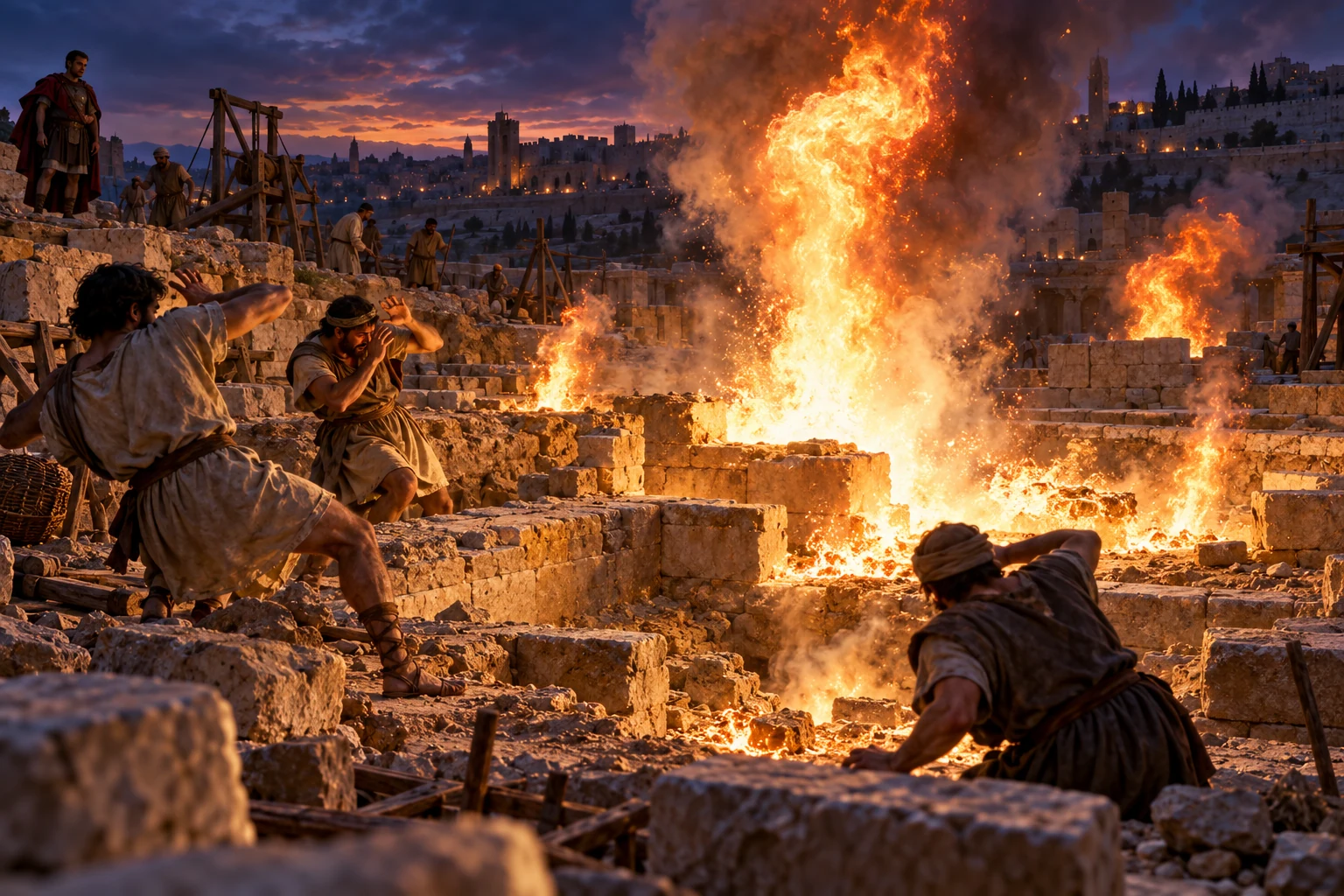
Imagine the scrape of tools against rubble, the weight of a lifted stone, and the sudden hush when the ground below becomes dangerous. These sounds and close-up actions create the scene; no invented worker is being presented as a named eyewitness.
Setting inspired by Ammianus 23.1.2–3 ↗
Separate the imagined sounds from the historian’s report.
Ancient report · non-graphic dramatization
3 · Fire halts the work
Ammianus reports repeated bursts of flame near the foundations, with fatal injuries, until the site becomes inaccessible and the project stops. The story pauses here. A completed new Temple is not destroyed in his account; the rebuilding enterprise is halted.
Does this source say a finished Temple was destroyed?
Patristic Christian interpretation
4 · A Christian witness to wonder
Gregory tells of earth movement, panic and flame; he also reports signs of the cross and presents the event as divine victory. In this Christian reading, the Lord prevents Julian’s purpose. Gregory’s sacred-place setting and added signs should be read in his own account, rather than inserted into Ammianus.
Gregory of Nazianzus, Oration 5.3–4 ↗
Which details and theological meaning belong specifically to Gregory?
Compare the accounts
5 · Keep the witnesses in view
Return to the foundations with both texts open. The fire and halted work form the shared core; Gregory supplies a more elaborate Christian telling. Historical reading preserves the supernatural testimony and its attribution, while leaving imagined dialogue, a precise cause of the fire and a finished building out of the factual record.
Ammianus 23.1.2–3; Gregory, Oration 5.3–4 ↗
What can you report confidently, and what must you attribute to a particular witness?
Read the historical accounts separately
Ammianus Marcellinus, Res Gestae 23.1.2–3 (J. C. Rolfe translation, 1940; LacusCurtius); Gregory of Nazianzus, Oration 5.3–4 (C. W. King translation, 1888). Both wrote after the event. Their reports are not identical, and neither excerpt establishes a modern physical explanation.
Ammianus · imperial plan and obstructing fire ↗
Gregory · divine intervention and signs ↗
Ammianus and Gregory report events from different perspectives; neither account is treated as a recording of every moment. This feature preserves the Christian supernatural interpretation without presenting all reported signs as details shared by every source.
Continue into the native geography explorer ↓ · Explore the native chronology →
Biblical Intelligence OS + Time & Calendar OS
Biblical Atlas & Timelines
Explore places, journeys, events, chronology, knowledge relationships, and calendar layers without losing the connected Scripture and evidence.Helpful Saints Biblical Atlas 2.0
Walk through place, time, calendar, and connected Scripture.
Coordinate-grounded geography, sourced journey relationships, evidence-labeled chronology, the live Zadok calendar, and the Biblical Knowledge Graph remain integrated without inventing uncertain boundaries or routes.LIVING HISTORY ATLAS
See the ancient world—and inspect what supports the view.
Historically informed reconstructions remain connected to Scripture, Corpus sources, geography, provenance, alternatives, and visible uncertainty.These exhibits are research interpretations, not photographs of the past. Helpful Saints identifies what is attested, inferred, disputed, unknown, or chosen artistically.
Person
Aaron — researched portrait
Exodus leadership period before formal high-priest investiture; Late Bronze Age Egypt/Sinai narrative setting, absolute date disputed.Artistic reconstruction linked to person:aaron. Identity, biography and life chronology remain owned by the existing Biblical People registry.
Person
Abdon — researched portrait
Abdon son of Hillel the Pirathonite, distinct from other men named Abdon. His large family does not establish precise age or physique. Apparent age 65 is artistic.Artistic reconstruction linked to person:abdon. Identity, biography and life chronology remain owned by the existing Biblical People registry.
Person
Abednego (Azariah) — researched portrait
Azariah, called Abednego in Daniel 1:7, as an adult Judean exile. Apparent age 28 is artistic. The prayer uses the Hebrew-form name in this English tradition.Artistic reconstruction linked to person:abednego. Identity, biography and life chronology remain owned by the existing Biblical People registry.
Person
Abigail — researched portrait
David and Nabal narrative in the southern Judean hill country; conventional early monarchy, around tenth century BCE, chronology uncertain. Portrait age approximately 32, artistic.Artistic reconstruction linked to person:abigail. Identity, biography and life chronology remain owned by the existing Biblical People registry.
Person
Abihu — researched portrait
Abihu son of Aaron, shown as an adult priest before the Leviticus 10 episode. Apparent age 31 is artistic. Family membership does not establish a shared exact face or age.Artistic reconstruction linked to person:abihu. Identity, biography and life chronology remain owned by the existing Biblical People registry.
Person
Abijah (Judah) — researched portrait
Abijah/Abijam son of Rehoboam, king of Judah, distinct from Jeroboam’s son Abijah and other namesakes. Apparent age 34 is artistic; uncertain age and civil chronology are not resolved by thiArtistic reconstruction linked to person:abijah. Identity, biography and life chronology remain owned by the existing Biblical People registry.
Person
Abimelech (son of Gideon) — researched portrait
Abimelech son of Gideon/Jerubbaal in Judges 9, distinct from kings of Gerar named Abimelech. This selects an ordinary adult moment before his fatal injury. Apparent age 33 is artistic.Artistic reconstruction linked to person:abimelech. Identity, biography and life chronology remain owned by the existing Biblical People registry.
Person
Abraham — researched portrait
Genesis 17–18 covenant/Mamre episode, elderly around 99–100 in narrative age; broad second-millennium BCE model disputed.Artistic reconstruction linked to person:abraham. Identity, biography and life chronology remain owned by the existing Biblical People registry.
Person
Absalom — researched portrait
Absalom son of David, selected as an adult before the revolt and fatal episode. His praised appearance and heavy hair are textual literary descriptions, not a measured face. Apparent age 29Artistic reconstruction linked to person:absalom. Identity, biography and life chronology remain owned by the existing Biblical People registry.
Person
Adam — researched portrait
Adult Adam after expulsion in the Genesis 2–5 narrative. Choose apparent age 45 artistically. No secure civil date, ethnic classification or archaeological culture is assigned.Artistic reconstruction linked to person:adam. Identity, biography and life chronology remain owned by the existing Biblical People registry.
Person
Ahab — researched portrait
Ahab son of Omri, king of Israel, distinct from other men named Ahab. Selected during ordinary adult reign before the final battle, without depicting moral character through facial stereotypArtistic reconstruction linked to person:ahab. Identity, biography and life chronology remain owned by the existing Biblical People registry.
Person
Ahaz — researched portrait
Ahaz son of Jotham, king of Judah, selected in ordinary adult life. His political and religious characterization does not establish facial traits. Apparent age 28 is artistic; no exact civilArtistic reconstruction linked to person:ahaz. Identity, biography and life chronology remain owned by the existing Biblical People registry.
Biblical Figure
Ahikar (Ahiqar) — interpretive portrait
Source-specific narrative; exact civil dates not assigned.A wisdom sage linked with Tobit and with the separate Story of Ahikar. The card keeps the literary witnesses and their variant names distinct.
Person
Amaziah — researched portrait
Amaziah son of Joash, king of Judah, distinct from Amaziah the priest and other namesakes. Selected as an adult before the later defeat and assassination. Apparent age 31 is artistic.Artistic reconstruction linked to person:amaziah. Identity, biography and life chronology remain owned by the existing Biblical People registry.
Person
Amon — researched portrait
Amon son of Manasseh, king of Judah, shown as a young adult during the brief reign. Apparent age 23 is an artistic selection consistent with the Biblical reign notice, not an exact reconstruArtistic reconstruction linked to person:amon. Identity, biography and life chronology remain owned by the existing Biblical People registry.
Person
Amos — researched portrait
Amos in an eighth-century BCE northern Israelite/Judean narrative setting. His herd and sycomore work is stated in Amos 7:14–15. Apparent age 49 is artistic; do not confuse priest Amaziah wiArtistic reconstruction linked to person:amos. Identity, biography and life chronology remain owned by the existing Biblical People registry.
Person
Ananias of Damascus — researched portrait
Disciple in Damascus in Acts9:10–19, meeting Saul after his vision. Approximate 30sCE narrative setting; exact year disputed. Distinct from Ananias of Acts5 and the later high priest. SelectArtistic reconstruction linked to person:ananias-damascus. Identity, biography and life chronology remain owned by the existing Biblical People registry.
Person
Andrew — researched portrait
Early-first-century CE Galilean fisherman, brother of Peter in Matthew4:18–20, adult38 artistic.Artistic reconstruction linked to person:andrew. Identity, biography and life chronology remain owned by the existing Biblical People registry.
Person
Andronicus — researched portrait
Romans 16:7 names him with Junia among Paul’s kinsmen and fellow-prisoners, already in Christ before Paul. Mid-first-century CE Roman Mediterranean context; actual birthplace and precise kinArtistic reconstruction linked to person:andronicus. Identity, biography and life chronology remain owned by the existing Biblical People registry.
Person
Anna the prophetess — researched portrait
Early first-century CE Jerusalem temple narrative; very elderly widow, age around 84 selected while the meaning of the number is uncertain.Artistic reconstruction linked to person:anna-prophetess. Identity, biography and life chronology remain owned by the existing Biblical People registry.
Person
Apollos — researched portrait
Mid-first-century CE Jewish man born in Alexandria teaching at Ephesus in Acts18:24–26, artistic age36. Birthplace/religion do not determine a single facial phenotype.Artistic reconstruction linked to person:apollos. Identity, biography and life chronology remain owned by the existing Biblical People registry.
Person
Aquila — researched portrait
Mid-first-century CE Acts narrative: Jew born in Pontus, artisan associated with Corinth, Priscilla and Paul; around 43 artistic.Artistic reconstruction linked to person:aquila. Identity, biography and life chronology remain owned by the existing Biblical People registry.
Person
Aristarchus — researched portrait
Acts 27:2 identifies a Macedonian of Thessalonica; Acts19:29 and Colossians4:10 connect him with Paul. Selected mid-first-century CE travel companion, age42 artistic. Geographic origin doesArtistic reconstruction linked to person:aristarchus. Identity, biography and life chronology remain owned by the existing Biblical People registry.
Person
Arphaxad — researched portrait
Arphaxad/Arpachshad son of Shem in Genesis 11. Apparent age 39 is artistic. Jubilees includes Kainam before Shelah, unlike the direct sequence in this KJV Genesis witness.Artistic reconstruction linked to person:arphaxad. Identity, biography and life chronology remain owned by the existing Biblical People registry.
Person
Asa — researched portrait
Asa king of Judah, selected during earlier adult reign, before the later disease notice. The narrative’s moral evaluation is not read from his face. Apparent age 38 is artistic.Artistic reconstruction linked to person:asa. Identity, biography and life chronology remain owned by the existing Biblical People registry.
Person
Asenath — researched portrait
Egyptian priest's daughter and Joseph's wife; portrait selects the new-robes conversion scene of Joseph and Aseneth 14.Artistic reconstruction linked to person:asenath. Identity, biography and life chronology remain owned by the existing Biblical People registry.
Person
Asher — researched portrait
Jacob-family pastoral Canaan narrative, illustrative second-millennium BCE setting; absolute chronology disputed. Son of Jacob and Zilpah; visual age 28 is artistic, not calculated from theArtistic reconstruction linked to person:asher. Identity, biography and life chronology remain owned by the existing Biblical People registry.
Person
Athaliah — researched portrait
Athaliah, queen ruling Judah in 2 Kings 11, selected in ordinary mature adult court life before her final confrontation. Her narrative role does not justify a theatrical villain face. AppareArtistic reconstruction linked to person:athaliah. Identity, biography and life chronology remain owned by the existing Biblical People registry.
Person
Balaam — researched portrait
Balaam son of Beor in Numbers 22–24, selected as an ordinary adult before the journey. The Deir Alla inscription’s Balaam tradition, if discussed later, cannot establish this face or exact iArtistic reconstruction linked to person:balaam. Identity, biography and life chronology remain owned by the existing Biblical People registry.
Person
Barak — researched portrait
Barak son of Abinoam of Kedesh in Naphtali, associated with Deborah. No battle or specific civil year is depicted. Apparent age 43 is artistic.Artistic reconstruction linked to person:barak. Identity, biography and life chronology remain owned by the existing Biblical People registry.
Person
Barnabas — researched portrait
Mid-first-century CE Jewish Levite from Cyprus named Joses/Barnabas in Acts4:36–37, artistic age50. Cyprus cultural setting with no deterministic facial phenotype.Artistic reconstruction linked to person:barnabas. Identity, biography and life chronology remain owned by the existing Biblical People registry.
Person
Bartholomew — researched portrait
Early first-century CE Gospel/Acts context; approximate portrait age 37, artistic.Artistic reconstruction linked to person:bartholomew. Identity, biography and life chronology remain owned by the existing Biblical People registry.
Person
Bathsheba — researched portrait
Jerusalem at the royal succession scene of 1 Kings 1; conventional tenth-century BCE narrative setting, not a bathing scene. Portrait age approximately 51, artistic.Artistic reconstruction linked to person:bathsheba. Identity, biography and life chronology remain owned by the existing Biblical People registry.
Person
Benjamin — researched portrait
Son of Jacob and Rachel; adult chosen from the brothers’ Egypt journey in Genesis 43–45, not an infant birth portrait. Illustrative second-millennium BCE setting, dates disputed. Age25 artisArtistic reconstruction linked to person:benjamin. Identity, biography and life chronology remain owned by the existing Biblical People registry.
Person
Bezalel — researched portrait
Bezalel son of Uri son of Hur, the Judahite artisan of Exodus 31. Apparent age 37 is artistic; skill does not establish age, exact appearance or a distinctive workshop uniform.Artistic reconstruction linked to person:bezalel. Identity, biography and life chronology remain owned by the existing Biblical People registry.
Person
Boaz — researched portrait
Bethlehem landowner and kinsman in Ruth, narrative situated in the time of the judges; broad early Iron Age southern Levant reconstruction, exact date disputed. Age56 artistically, not stateArtistic reconstruction linked to person:boaz. Identity, biography and life chronology remain owned by the existing Biblical People registry.
Person
Caleb — researched portrait
Caleb son of Jephunneh, selected during the reconnaissance narrative rather than his later old age. Distinguish him from Caleb son of Hezron and other namesakes. Apparent age 40 is artisticArtistic reconstruction linked to person:caleb. Identity, biography and life chronology remain owned by the existing Biblical People registry.
Person
Cornelius — researched portrait
Mid-first-century CE Roman centurion at Caesarea, Italian cohort in Acts10:1–8; artistic age42, birthplace and phenotype not established by unit name.Artistic reconstruction linked to person:cornelius. Identity, biography and life chronology remain owned by the existing Biblical People registry.
Person
Cyrus the Great — researched portrait
Cyrus II, Achaemenid ruler, in a late-sixth-century BCE narrative setting around the Babylonian return. Apparent age 57 is artistic. Inscriptions attest the ruler, not this face; later relieArtistic reconstruction linked to person:cyrus. Identity, biography and life chronology remain owned by the existing Biblical People registry.
Person
Dan — researched portrait
Jacob-family pastoral Canaan narrative, illustrative second-millennium BCE setting; absolute chronology disputed. Son of Jacob and Bilhah; visual age 33 is artistic, not calculated from theArtistic reconstruction linked to person:dan. Identity, biography and life chronology remain owned by the existing Biblical People registry.
Person
Daniel — researched portrait
Adult Daniel in the Babylonian court narrative, not the initial youthful arrival. Apparent age 38 is artistic. The narrative setting is sixth-century BCE; the book’s composition is a separatArtistic reconstruction linked to person:daniel. Identity, biography and life chronology remain owned by the existing Biblical People registry.
Person
David — researched portrait
Early kingship in the Judean highlands, approximately early 10th century BCE; model dates disputed.Artistic reconstruction linked to person:david. Identity, biography and life chronology remain owned by the existing Biblical People registry.
Person
Deborah — researched portrait
Judges-period hill country of Ephraim; conventional early Iron Age narrative setting, precise date disputed. Portrait age approximately 50, artistic.Artistic reconstruction linked to person:deborah. Identity, biography and life chronology remain owned by the existing Biblical People registry.
Person
Dinah — researched portrait
Jacob-family narrative near Shechem, illustrative second-millennium BCE pastoral Levant setting; precise date and age not established. Portrait age approximately 19, artistic.Artistic reconstruction linked to person:dinah. Identity, biography and life chronology remain owned by the existing Biblical People registry.
Person
Eber — researched portrait
Eber son of Shelah and father of Peleg in Genesis 11:14–17. Apparent age 56 is artistic; no secure civil date or archaeological culture is assigned.Artistic reconstruction linked to person:eber. Identity, biography and life chronology remain owned by the existing Biblical People registry.
Person
Ehud — researched portrait
Ehud son of Gera, a Benjaminite. Left-handedness is textual but no hands appear in this head-and-torso portrait. Apparent age 32 is artistic.Artistic reconstruction linked to person:ehud. Identity, biography and life chronology remain owned by the existing Biblical People registry.
Person
Eleazar — researched portrait
Eleazar son of Aaron, selected during earlier service while Aaron is still high priest. Apparent age 39 is artistic. His later high-priestly succession in Numbers 20 is a different moment.Artistic reconstruction linked to person:eleazar. Identity, biography and life chronology remain owned by the existing Biblical People registry.
Person
Eli — researched portrait
Eli, priest and judge at Shiloh, selected during earlier older-adult life before the final blindness and death notice of 1 Samuel 4. Apparent age 76 is artistic, not an exact date. OrdinaryArtistic reconstruction linked to person:eli. Identity, biography and life chronology remain owned by the existing Biblical People registry.
Person
Elijah — researched portrait
Elijah the Tishbite in a ninth-century BCE northern Israelite narrative setting. Apparent age 60 is artistic. Second Kings 1:8’s hairy wording can concern hair or a hair garment; precise appArtistic reconstruction linked to person:elijah. Identity, biography and life chronology remain owned by the existing Biblical People registry.
Person
Elisha — researched portrait
Elisha son of Shaphat in a ninth-century BCE northern Israelite narrative setting. Apparent age 52 is artistic. Baldness is a textual cue in 2 Kings 2:23; its exact extent and medical causeArtistic reconstruction linked to person:elisha. Identity, biography and life chronology remain owned by the existing Biblical People registry.
Person
Elon — researched portrait
Elon the Zebulunite judge, distinct from the other men named Elon. The brief Biblical notice gives no exact face or personal costume. Apparent age 50 is artistic.Artistic reconstruction linked to person:elon. Identity, biography and life chronology remain owned by the existing Biblical People registry.
Person
Enoch — researched portrait
Enoch son of Jared in Genesis 5:18–24, distinct from Cain’s son Enoch. Apparent adult age 40 is artistic. Enochic literature and Jubilees provide later witness-specific literary roles, not aArtistic reconstruction linked to person:enoch. Identity, biography and life chronology remain owned by the existing Biblical People registry.
Person
Enosh — researched portrait
Enosh son of Seth, also Enos in some translations, in Genesis 4:26 and 5:6–11. Apparent adult age 60 is artistic. He is not Enoch.Artistic reconstruction linked to person:enosh. Identity, biography and life chronology remain owned by the existing Biblical People registry.
Person
Epaphroditus — researched portrait
Philippian messenger and companion described in Philippians2:25–30 and4:18, mid-first-centuryCE. Depict him after recovery, without diagnosing a disease or choosing an unproved prison locatiArtistic reconstruction linked to person:epaphroditus. Identity, biography and life chronology remain owned by the existing Biblical People registry.
Person
Ephraim — researched portrait
Egypt-born younger son of Joseph and Asenath in Genesis 41:50–52. Selected later young adulthood, not the Genesis 48 blessing moment. Illustrative second-millennium BCE Egypt, dynasty and abArtistic reconstruction linked to person:ephraim. Identity, biography and life chronology remain owned by the existing Biblical People registry.
Person
Esau — researched portrait
Adult hunter in Genesis 25–27; age about 55 is an artistic life-stage choice, absolute dates disputed.Artistic reconstruction linked to person:esau. Identity, biography and life chronology remain owned by the existing Biblical People registry.
Person
Esther — researched portrait
Jewish woman in the Susa/Persian court narrative, conventionally fifth century BCE Achaemenid setting; historicity and identification disputed.Artistic reconstruction linked to person:esther. Identity, biography and life chronology remain owned by the existing Biblical People registry.
Person
Eunice — researched portrait
Mid-first-century CE Timothy-family setting in Anatolia, Jewish mother identified indirectly through Acts16:1 and named in 2Timothy1:5. Artistic age50.Artistic reconstruction linked to person:eunice. Identity, biography and life chronology remain owned by the existing Biblical People registry.
Person
Eve — researched portrait
Adult Eve after expulsion, within Genesis 2–4. Apparent age 38 is artistic, not inferred from a genealogy or modern population category.Artistic reconstruction linked to person:eve. Identity, biography and life chronology remain owned by the existing Biblical People registry.
Person
Ezekiel — researched portrait
Ezekiel son of Buzi, priest and prophet among exiles in a sixth-century BCE Babylonian narrative setting. Apparent age 40 is artistic; the book’s thirtieth year is not asserted as a certainArtistic reconstruction linked to person:ezekiel. Identity, biography and life chronology remain owned by the existing Biblical People registry.
Person
Ezra — researched portrait
Ezra the priest and scribe in a fifth-century BCE Persian-period Judean narrative setting. Apparent age 55 is artistic. Priesthood does not establish the exact clothing of this portrait or mArtistic reconstruction linked to person:ezra. Identity, biography and life chronology remain owned by the existing Biblical People registry.
Angelic-figure
Gabriel — interpretive portrait
Textual and reception settings; no civil lifespan asserted.Gabriel interprets visions in Daniel and brings messages in Luke. Read each literary setting before borrowing details from later images of the angel.
Person
Gabriel (angel) — symbolic source-specific portrait
UNKNOWN; source-specific literary and interpretive contextsSymbolic visualization of person:gabriel-angel. Source-specific identity is admitted through the existing native registry; no historical human likeness, lifespan or coordinates are claimed.
Person
Gad — researched portrait
Jacob-family pastoral Canaan narrative, illustrative second-millennium BCE setting; absolute chronology disputed. Son of Jacob and Zilpah; visual age 30 is artistic, not calculated from theArtistic reconstruction linked to person:gad. Identity, biography and life chronology remain owned by the existing Biblical People registry.
Person
Gamaliel — researched portrait
First-century CE Jerusalem Pharisee/law teacher in Acts5:34; elderly about62 artistically. Traditional association with Gamaliel the Elder in Mishnah Sotah9:15 is a later-text comparison, noArtistic reconstruction linked to person:gamaliel. Identity, biography and life chronology remain owned by the existing Biblical People registry.
Person
Gideon — researched portrait
Gideon son of Joash the Abiezrite, also called Jerubbaal. The ordinary portrait precedes battle and avoids treating prowess as a verified physique. Apparent age 36 is artistic.Artistic reconstruction linked to person:gideon. Identity, biography and life chronology remain owned by the existing Biblical People registry.
Biblical Figure
Goliath of Gath — interpretive portrait
Source-specific narrative; exact civil dates not assigned.The Philistine champion who faces David in 1 Samuel 17. His card compares the Biblical narrative with Josephus’s different height reading.
Person
Habakkuk — researched portrait
Habakkuk the prophet in a late-monarchy/Chaldean narrative horizon. Exact years and biography are uncertain. Apparent age 50 is artistic. The Habakkuk in Bel and the Dragon is a later literaArtistic reconstruction linked to person:habakkuk. Identity, biography and life chronology remain owned by the existing Biblical People registry.
Person
Hagar — researched portrait
Egyptian woman in Abraham's Canaan narrative, broadly second millennium BCE; exact historical dating disputed.Artistic reconstruction linked to person:hagar. Identity, biography and life chronology remain owned by the existing Biblical People registry.
Person
Haggai — researched portrait
Haggai in the late-sixth-century BCE return-and-temple narrative under Darius. Apparent age 66 is artistic. Neither the Biblical heading nor the later Life establishes his precise age.Artistic reconstruction linked to person:haggai. Identity, biography and life chronology remain owned by the existing Biblical People registry.
Person
Ham — researched portrait
Ham son of Noah and father of Canaan in Genesis 9–10. Adult appearance about 44 is artistic. Genesis does not describe skin-color transformation; do not encode any moral quality or curse inArtistic reconstruction linked to person:ham. Identity, biography and life chronology remain owned by the existing Biblical People registry.
Person
Herod Agrippa I — researched portrait
First-century CE king in the Caesarea theater-stage account of Josephus XIX.8.2, represented around53 following death in his fifty-fourth year. Distinct from Marcus Vipsanius Agrippa, AgrippArtistic reconstruction linked to person:herod-agrippa-i. Identity, biography and life chronology remain owned by the existing Biblical People registry.
Person
Herod Antipas — researched portrait
Early-first-century CE Galilean tetrarch, artistic age50, distinct from Herod the Great and Agrippa I. Luke3 and Josephus XVIII provide office/context without a verified face.Artistic reconstruction linked to person:herod-antipas. Identity, biography and life chronology remain owned by the existing Biblical People registry.
Person
Herod the Great — researched portrait
Late-first-century BCE Judean client-king setting, elderly about65 artistically. Follow the black-dyed-hair report in Josephus XVI.8.1 while qualifying it as an accusation reported in a tortArtistic reconstruction linked to person:herod-the-great. Identity, biography and life chronology remain owned by the existing Biblical People registry.
Person
Hezekiah — researched portrait
Hezekiah son of Ahaz, king of Judah, selected in ordinary adult life before the illness episode. Apparent age 35 is artistic. Historical textual witnesses do not provide this face.Artistic reconstruction linked to person:hezekiah. Identity, biography and life chronology remain owned by the existing Biblical People registry.
Person
Hiram of Tyre — researched portrait
Hiram king of Tyre associated with David and Solomon, distinct from the bronze artisan of 1 Kings 7. Apparent age 51 is artistic. Later letters quoted by Josephus remain literary transmissioArtistic reconstruction linked to person:hiram. Identity, biography and life chronology remain owned by the existing Biblical People registry.
Person
Hosea — researched portrait
Hosea son of Beeri in an eighth-century BCE northern Israelite narrative setting. Apparent age 42 is artistic. Later birth and burial traditions do not establish his verified appearance.Artistic reconstruction linked to person:hosea. Identity, biography and life chronology remain owned by the existing Biblical People registry.
Person
Hoshea — researched portrait
Hoshea son of Elah, the northern king in 2 Kings 17, distinct from Joshua’s earlier name Hoshea and the prophet Hosea. Selected during adult reign before captivity. Apparent age 36 is artistArtistic reconstruction linked to person:hoshea. Identity, biography and life chronology remain owned by the existing Biblical People registry.
Person
Hur — researched portrait
Hur who assists Moses with Aaron in Exodus 17 and is left with Aaron in Exodus 24:14. Do not automatically merge every Hur or the later spouse tradition. Apparent age 63 is artistic; ExodusArtistic reconstruction linked to person:hur. Identity, biography and life chronology remain owned by the existing Biblical People registry.
Person
Ibzan — researched portrait
Ibzan of Bethlehem, the judge in Judges 12:8–10. The text does not establish which Bethlehem here. Do not turn later identification with Boaz into a verified identity. Apparent age 62 is artArtistic reconstruction linked to person:ibzan. Identity, biography and life chronology remain owned by the existing Biblical People registry.
Person
Isaac — researched portrait
Adult marriage-stage portrait, narrative age 40 in Genesis 25:20; southern Canaan context, absolute dating disputed.Artistic reconstruction linked to person:isaac. Identity, biography and life chronology remain owned by the existing Biblical People registry.
Person
Isaiah — researched portrait
Isaiah son of Amoz in an eighth-century BCE Judean narrative setting. Apparent age 58 is artistic. The historical prophet’s career is separate from questions about the composition of the whoArtistic reconstruction linked to person:isaiah. Identity, biography and life chronology remain owned by the existing Biblical People registry.
Person
Ishmael — researched portrait
Son of Abraham and Hagar, adult in the Paran wilderness narrative of Genesis 21; illustrative second-millennium BCE regional setting, dates and exact geography disputed. Age29 artistically.Artistic reconstruction linked to person:ishmael. Identity, biography and life chronology remain owned by the existing Biblical People registry.
Person
Issachar — researched portrait
Son of Jacob and Leah, adult pastoral/agricultural Canaan narrative; illustrative second millennium BCE, absolute chronology disputed. Age32 artistically.Artistic reconstruction linked to person:issachar. Identity, biography and life chronology remain owned by the existing Biblical People registry.
Person
Ithamar — researched portrait
Ithamar son of Aaron in the Exodus priestly and sanctuary-accounting traditions. Apparent age 30 is artistic. His responsibilities do not establish a precise likeness, age or professional unArtistic reconstruction linked to person:ithamar. Identity, biography and life chronology remain owned by the existing Biblical People registry.
Person
Jacob — researched portrait
Very elderly at arrival in Egypt in Genesis 47; narrative age 130, absolute chronology disputed.Artistic reconstruction linked to person:jacob. Identity, biography and life chronology remain owned by the existing Biblical People registry.
Person
Jair — researched portrait
Jair the Gileadite judge in Judges 10, distinct from other men named Jair. The sons and settlements are narrative details, not a verified appearance. Apparent age 61 is artistic.Artistic reconstruction linked to person:jair. Identity, biography and life chronology remain owned by the existing Biblical People registry.
Person
James (brother of Jesus) — researched portrait
Mid-first-century CE Jerusalem, James the Just. Follow the specific Hegesippus portrait tradition preserved by EusebiusII.23.4–7, not a verified likeness. Artistically around55.Artistic reconstruction linked to person:james-brother-of-jesus. Identity, biography and life chronology remain owned by the existing Biblical People registry.
Person
James (son of Alphaeus) — researched portrait
Early first-century CE Gospel/Acts context; approximate portrait age 31, artistic.Artistic reconstruction linked to person:james-son-of-alphaeus. Identity, biography and life chronology remain owned by the existing Biblical People registry.
Person
James (son of Zebedee) — researched portrait
Early-first-century CE Galilean fisherman and disciple, brother of John, before the death recorded in Acts12:1–2. Artistic age38; distinct from James Lord’s brother and James Alphaeus.Artistic reconstruction linked to person:james-son-of-zebedee. Identity, biography and life chronology remain owned by the existing Biblical People registry.
Person
Japheth — researched portrait
Japheth son of Noah in Genesis 9–10. Adult appearance about 46 is artistic. Literary territories in later tradition do not determine modern ethnicity, phenotype or exact location.Artistic reconstruction linked to person:japheth. Identity, biography and life chronology remain owned by the existing Biblical People registry.
Person
Jared — researched portrait
Jared son of Mahalalel and father of Enoch in Genesis 5:15–20. Apparent age 62 is artistic. Later Watcher traditions do not establish his appearance.Artistic reconstruction linked to person:jared. Identity, biography and life chronology remain owned by the existing Biblical People registry.
Person
Jehoiachin — researched portrait
Jehoiachin/Jeconiah, son of Jehoiakim, selected as an adult during Babylonian exile rather than at accession. Apparent age 30 is artistic and does not resolve differing accession-age readingArtistic reconstruction linked to person:jehoiachin. Identity, biography and life chronology remain owned by the existing Biblical People registry.
Person
Jehoiakim — researched portrait
Jehoiakim, the renamed Eliakim son of Josiah, king of Judah, distinct from his son Jehoiachin. Shown as an ordinary adult before the final events of his reign. Apparent age 30 is artistic.Artistic reconstruction linked to person:jehoiakim. Identity, biography and life chronology remain owned by the existing Biblical People registry.
Person
Jehoshaphat — researched portrait
Jehoshaphat son of Asa, king of Judah, distinct from officials of the same name. Shown as a mature adult; apparent age 42 is artistic and no exact civil year is fixed.Artistic reconstruction linked to person:jehoshaphat. Identity, biography and life chronology remain owned by the existing Biblical People registry.
Person
Jehu — researched portrait
Jehu son of Jehoshaphat son of Nimshi, king of Israel, distinct from Jehu son of Hanani the prophet. An ordinary adult moment is selected, without a battle or killing scene. Apparent age 44Artistic reconstruction linked to person:jehu. Identity, biography and life chronology remain owned by the existing Biblical People registry.
Person
Jephthah — researched portrait
Jephthah the Gileadite of Judges 11–12. The portrait selects ordinary adult life and does not depict the vow or its violence. No exact civil date is fixed. Apparent age 45 is artistic.Artistic reconstruction linked to person:jephthah. Identity, biography and life chronology remain owned by the existing Biblical People registry.
Person
Jeremiah — researched portrait
Jeremiah son of Hilkiah, an adult prophet in a late-seventh/early-sixth-century BCE Judean narrative setting. Apparent age 44 is artistic, not the age of his youthful call.Artistic reconstruction linked to person:jeremiah. Identity, biography and life chronology remain owned by the existing Biblical People registry.
Person
Jeroboam I — researched portrait
Jeroboam son of Nebat, the first northern king in the division narrative, distinct from Jeroboam son of Joash. Selected as an ordinary adult without ritual props. Apparent age 42 is artisticArtistic reconstruction linked to person:jeroboam. Identity, biography and life chronology remain owned by the existing Biblical People registry.
Person
Jeshua (high priest) — researched portrait
Jeshua/Joshua son of Jozadak/Jehoshadak, the high priest in the return narrative, distinct from Joshua son of Nun and Jesus of Nazareth. Selected in ordinary adult rest clothing; Zechariah 3Artistic reconstruction linked to person:jeshua-high-priest. Identity, biography and life chronology remain owned by the existing Biblical People registry.
Interactive Biblical Geography
Coordinate-grounded places and sourced route relationships.
This is a longitude-and-latitude place explorer—not an invented historical boundary map. Route lines show selected textual relationships and do not assert uncertain paths.Scroll the plot sideways to explore. Use Select a place or Browse places for direct navigation.
Browse places without the map
- JerusalemJudea · 2 Samuel 5; Gospels; Acts
- BethlehemJudea · Micah 5:2; Matthew 2; Luke 2
- NazarethGalilee · Matthew 2:23; Luke 1–4
- CapernaumGalilee · Matthew 4; Mark 1–2
- Caesarea PhilippiNorthern Galilee · Matthew 16; Mark 8
- DamascusSyria · Acts 9
- Antioch on the OrontesSyria · Acts 11–15
- TarsusCilicia · Acts 9:11; 21:39
- EphesusAsia Minor · Acts 18–20; Ephesians
- CorinthAchaia · Acts 18; 1–2 Corinthians
- PhilippiMacedonia · Acts 16; Philippians
- RomeItaly · Acts 28; Romans
Map integrity: no coastlines, territorial boundaries, archaeological certainty, or disputed route geometry are fabricated.
Scripture Timeline Explorer
Sequence, historical range, model, and undated hope remain distinct.
Filter eras, inspect events, open references, and send a chronology question to Scripture AI. Approximate ranges are labeled rather than presented as exact biblical dates.HELPFUL SAINTS · ZADOK CALENDAR
An ancient sacred calendar.
A living instrument from the future.
Explore the governed 364-day framework, inspect sacred dates, compare the reconstruction model, and follow every claim back to its evidence.
The next appointed moments, already in view.
Select any event to move the living instrument to that governed date and inspect its evidence.
Understand every ring. Follow every claim.
The interface separates manuscript-grounded structure from Helpful Saints’ clearly labeled modern compatibility reconstruction.
364 days
Four 91-day seasons form 52 complete weeks. The weekday pattern therefore remains stable within the governed model.
Wednesday opening
The research model begins the year on the fourth day, following the calendrical interpretation preserved in the Qumran evidence.
Twelve month sectors
The month ring makes sacred dates immediately inspectable while preserving the actual calculation engine underneath.
Feasts & Tekufot
Markers open the selected date, supporting Scripture, classification, and evidence notes without changing the calendar mathematics.
5951 AM reconstruction
AM chronology, Gregorian anchor, Jubilee notation, and intercalation are visibly identified as modern reconstruction choices.
Inspect the sources
Use Sources & Model or send the selected date to Scripture AI for a classified, provenance-rich study.
Sources & reconstruction modelWhat is manuscript-grounded, and what is a modern compatibility reconstruction?
Keyboard & movement controls
Biblical Knowledge Graph 2.0
Explore relationships while keeping evidence classifications visible.
Focus a node, filter evidence and entity types, inspect relationship language, and open connected Scripture or Scripture AI. A connection is not automatic proof of identity.Interactive Research Path
Always know where you are—and what comes next.
The stages are a guide rather than a rigid requirement. Move directly to the tool your evidence requires.Open the complete Live Zadok Calendar.
The full calendar retains feast, Tekufot, civil conversion, comparison, and model-disclosure space.
Open Live Zadok Calendar