THREE TEMPLES · DISTINCT WITNESSES · A CLOSER LOOK
Study the measurements.
Explore Solomon’s Temple, the Second Temple, and Ezekiel’s visionary Temple, including a future-Temple reading. Turn a study model, open its rooms, and follow a dimension to its source.
Built Temple · textual reconstruction
First Temple · Solomon
Explore the long sanctuary, the inner room and the bronze furnishings. The measured core follows Kings; the surrounding architecture in the painting is interpreted.
Listen to the editorial study
AI-generated narration reads the editorial explanation. Cited texts retain their own wording and editions.
English name-reading helps
These are English reading choices, not claims to reconstruct ancient pronunciation: Melchizedek (mel-KIZ-uh-dek), Ezekiel (ih-ZEE-kee-uhl), Mahaway (muh-HAH-way), Qumran (KOOM-rahn), Zadok (ZAY-dok), Jubilees (JOO-bih-leez), Jasher (JASH-er). Device voices may vary.
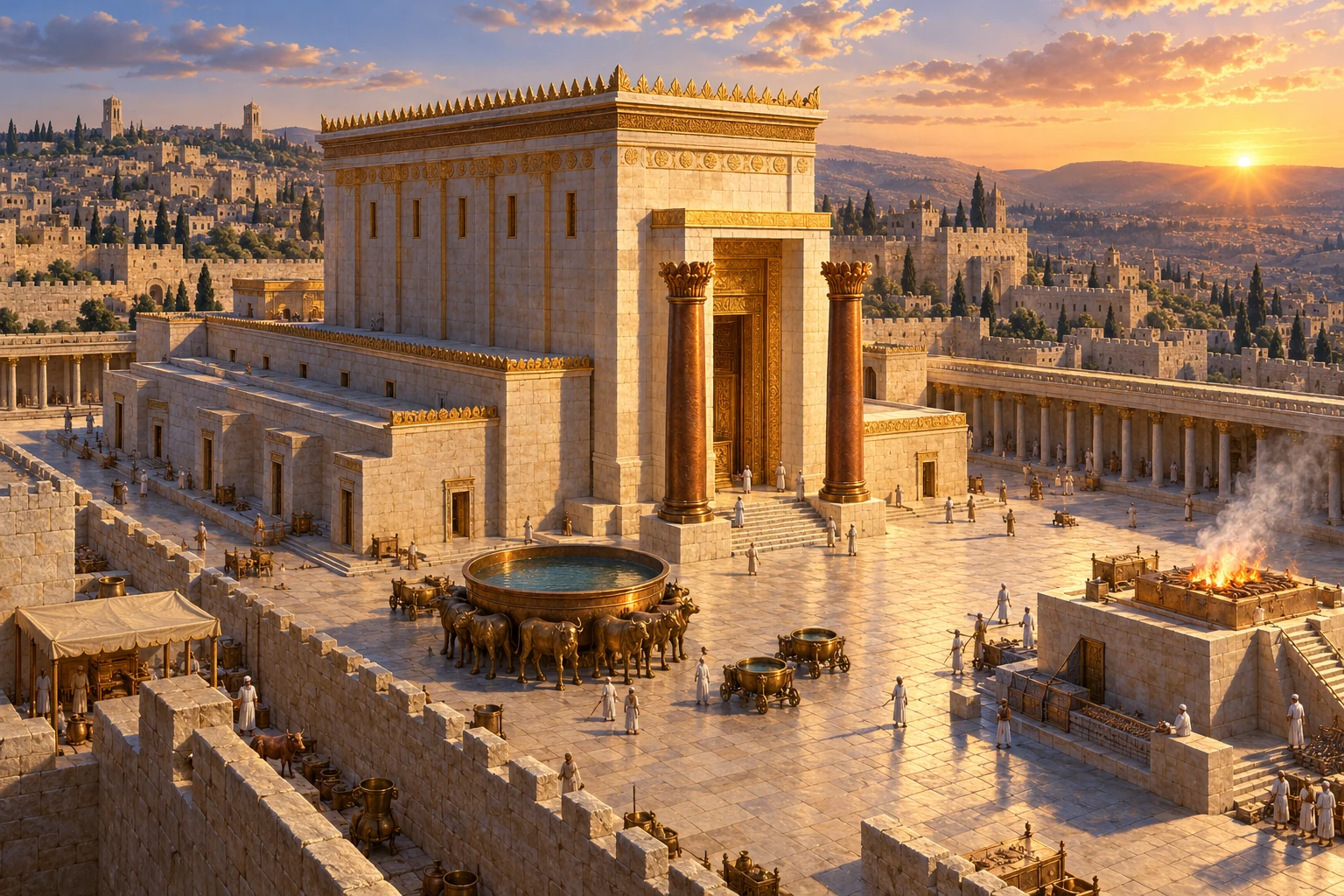
Drag horizontally to turn, or use the buttons and keyboard. The model stays still until you move it.
A partial study model of the house and selected furnishings, not a complete surveyed reconstruction. Kings and Chronicles are separate descriptions. Courtyard layout, wall thickness, porch height and furnishings’ exact positions are schematic.
Chronology, sources & reconstruction choices
Solomon’s reign; the construction sequence is given by regnal year in 1 Kings 6:1, 37–38. This explorer does not assign a new absolute date.
Ancient cubits vary. The optional conversions use illustrative values of 0.45 m per ordinary cubit and 0.525 m per long cubit; they do not determine the ancient standard. Compare textual cubits first. A projected dimension cannot be measured accurately from perspective pixels.
3D geometry expresses selected measurements. Decorative details, exact archaeological placement, complete engineering structure and every room are not reconstructed. A future architectural refinement can extend this same source-linked model.
Second Temple phases: Ezra 3–6 · early rebuilding ↗ · Josephus · late Temple ↗ · Mishnah Middot · separate witness ↗
Compare all three · measurements and witnesses
Each entry keeps its source. Equal numbers do not make the buildings identical; Ezekiel uses the long cubit.
First Temple · Solomon
| Feature | Measurement | Source & qualification |
|---|---|---|
| The house | 60 × 20 × 30 cubits | 1 Kings 6:2 ↗ The model uses this envelope; thin display walls do not establish ancient wall thickness. |
| The main hall | 40 cubits long; 20 cubits wide | 1 Kings 6:16–17 ↗ The colored floor separates the rooms. Door construction and floor levels are simplified. |
| The inner sanctuary | 20 × 20 × 20 cubits | 1 Kings 6:19–20 ↗ The cutaway opens a room normally enclosed. This simplified diagram omits the Ark and great cherubim. Their textual dimensions and the artistic choices in their forms are distinguished in the detailed study. |
| The entrance porch | 20 cubits across × 10 cubits deep | 1 Kings 6:3; 2 Chronicles 3:4 ↗ Only the footprint is measured here; the model does not silently replace 120 with another height. |
| Jachin and Boaz | 18 cubits high; 12 cubits around; capitals 5 cubits | 1 Kings 7:15–22 ↗ Round shafts approximate a twelve-cubit circumference. Capital ornament and placement are simplified. |
| The bronze sea | 10 cubits across × 5 cubits high | 1 Kings 7:23–26, 39 ↗ A cylindrical marker shows the basin’s named span and height. Its supports and curved profile are not reconstructed. |
| The bronze altar | 20 × 20 × 10 cubits | 2 Chronicles 4:1 ↗ Its position in front of the house is a diagrammatic arrangement; the model does not supply stairs, horns or construction details. |
Second Temple · Herodian phase
| Feature | Measurement | Source & qualification |
|---|---|---|
| The monumental front | 100 cubits wide × 100 cubits high | Josephus, Jewish War 5.5.4 ↗ The facade is shown as a thin dimensional frame. Its four-cubit display depth is schematic, not a quoted ancient measurement. |
| The first opening | 70 cubits high × 25 cubits wide | Josephus, Jewish War 5.5.4 ↗ The opening is cut through the dimensional front frame; ornamental details are omitted. |
| The inner house | 60 cubits long × 20 wide × 60 high | Josephus, Jewish War 5.5.5 ↗ The interior volume is shown separately from the hundred-cubit front. This is not the total external building length. |
| The main room | 40 cubits long | Josephus, Jewish War 5.5.5 ↗ The colored floor marks the room in this dimensional diagram. The optional 3D prototype includes interpretive furnishings; their forms, sizes and positions are not supplied by this room measurement. |
| The Holy of Holies | 20 cubits long | Josephus, Jewish War 5.5.5 ↗ This model places no Ark in the late Second Temple room. The text’s empty room is preserved. |
| Before Herod: rebuilding after exile | A decree is not an as-built survey | Ezra 3:8–13; 6:3–5, 14–16 ↗ No detailed early Second Temple model is fabricated from the Herodian description. Read the earlier history as its own phase. |
| The exterior altar · dimensional study | 50 × 50 × 15 cubits · length, width, height | Josephus, Jewish War 5.5.6 ↗ This native diagram has no exterior altar feature. The optional detached study shows a dimensional envelope, not a completed altar design. Profile, horns, ramp and exact placement remain unresolved; no courtyard layout or measured house offset is supplied. These dimensions do not apply to the interior incense altar. |
Ezekiel’s visionary Temple · future-Temple reading
| Feature | Measurement | Source & qualification |
|---|---|---|
| The measuring reed | 6 long cubits; each a cubit plus a handbreadth | Ezekiel 40:5 ↗ Geometry remains in the source’s long cubits. Modern conversion is optional and approximate. |
| The main hall | 40 × 20 long cubits | Ezekiel 41:1–2 ↗ Floor dimensions are measured. Displayed wall heights and thicknesses are schematic. |
| The most holy place | 20 × 20 long cubits | Ezekiel 41:3–4 ↗ The model does not borrow Solomon’s twenty-cubit room height; Ezekiel’s passage here supplies length and width. |
| The inner court | 100 × 100 long cubits | Ezekiel 40:47 ↗ The court footprint is measured; the exact altar offset is schematic. |
| The gatehouses | 50 long × 25 wide; cells 6 × 6 long cubits | Ezekiel 40:7, 13, 15, 21, 28–37 ↗ Footprint blocks indicate the gatehouses in this dimensional diagram, not a fully solved elevation. The optional east-gate prototype includes cells and stairs, with its reconstruction choices disclosed separately. |
| The altar hearth | 12 × 12 long cubits | Ezekiel 43:13–17 ↗ A flat square marks the hearth’s span. The stepped altar’s detailed elevation is not inferred from a simple box. |
| Which outer boundary? | 500 cubits or 500 reeds in the textual witnesses | Ezekiel 42:15–20; 45:2 ↗ Switch boundary readings to see 500 versus 3,000 long cubits. The house and courts keep their dimensions; the larger boundary is not stretched into them. |
| Priests and holy space | The sons of Zadok are named | Ezekiel 40:45–46; 44:15–16 ↗ This is a textual connection, not a new genealogy or archaeological identification. |
| Water from the house | Measured stages at 1,000 cubits | Ezekiel 47:1–12 ↗ The atmospheric painting imagines its appearance. No modern hydrological survey or mapped river route is claimed. |
The Temple Scroll · another textual vision
The Temple Scroll (11Q19) describes another ideal Temple arrangement. It is a separate manuscript witness, not an alternative label for Ezekiel’s plan. Open its current original-language edition in the Scripture Library; no unlicensed modern translation is reproduced.
Open the Temple Scroll in the native Library →ANCIENT HISTORY · CHRISTIAN MEMORY · DRAMATIC READING
The work that stopped · Jerusalem, AD 363
Julian’s attempted rebuilding is a striking episode in Christian memory. Read a dramatic retelling beside the ancient accounts: one reports the obstructing fire; another understands it as an act of God. It is not described here as the last rebuilding effort in all later history.
This reading mentions fatal injuries without depicting them. The dramatic sounds and settings are original imagined additions; no invented dialogue is presented as testimony.
Listen to the editorial study
AI-generated narration reads the editorial explanation. Cited texts retain their own wording and editions.
English name-reading helps
These are English reading choices, not claims to reconstruct ancient pronunciation: Melchizedek (mel-KIZ-uh-dek), Ezekiel (ih-ZEE-kee-uhl), Mahaway (muh-HAH-way), Qumran (KOOM-rahn), Zadok (ZAY-dok), Jubilees (JOO-bih-leez), Jasher (JASH-er). Device voices may vary.
Ancient report
1 · An emperor’s plan
Julian directs resources toward rebuilding the Temple in Jerusalem and places Alypius in charge. In the retelling, imagine plans spreading across a worktable and tools being gathered. The preparations set the scene; the worktable is imagined.
Which named official does Ammianus place in charge?
Dramatized setting
2 · At the foundations
Imagine the scrape of tools against rubble, the weight of a lifted stone, and the sudden hush when the ground below becomes dangerous. These sounds and close-up actions create the scene; no invented worker is being presented as a named eyewitness.
Setting inspired by Ammianus 23.1.2–3 ↗
Separate the imagined sounds from the historian’s report.
Ancient report · non-graphic dramatization
3 · Fire halts the work
Ammianus reports repeated bursts of flame near the foundations, with fatal injuries, until the site becomes inaccessible and the project stops. The story pauses here. A completed new Temple is not destroyed in his account; the rebuilding enterprise is halted.
Does this source say a finished Temple was destroyed?
Patristic Christian interpretation
4 · A Christian witness to wonder
Gregory tells of earth movement, panic and flame; he also reports signs of the cross and presents the event as divine victory. In this Christian reading, the Lord prevents Julian’s purpose. Gregory’s sacred-place setting and added signs should be read in his own account, rather than inserted into Ammianus.
Gregory of Nazianzus, Oration 5.3–4 ↗
Which details and theological meaning belong specifically to Gregory?
Compare the accounts
5 · Keep the witnesses in view
Return to the foundations with both texts open. The fire and halted work form the shared core; Gregory supplies a more elaborate Christian telling. Historical reading preserves the supernatural testimony and its attribution, while leaving imagined dialogue, a precise cause of the fire and a finished building out of the factual record.
Ammianus 23.1.2–3; Gregory, Oration 5.3–4 ↗
What can you report confidently, and what must you attribute to a particular witness?
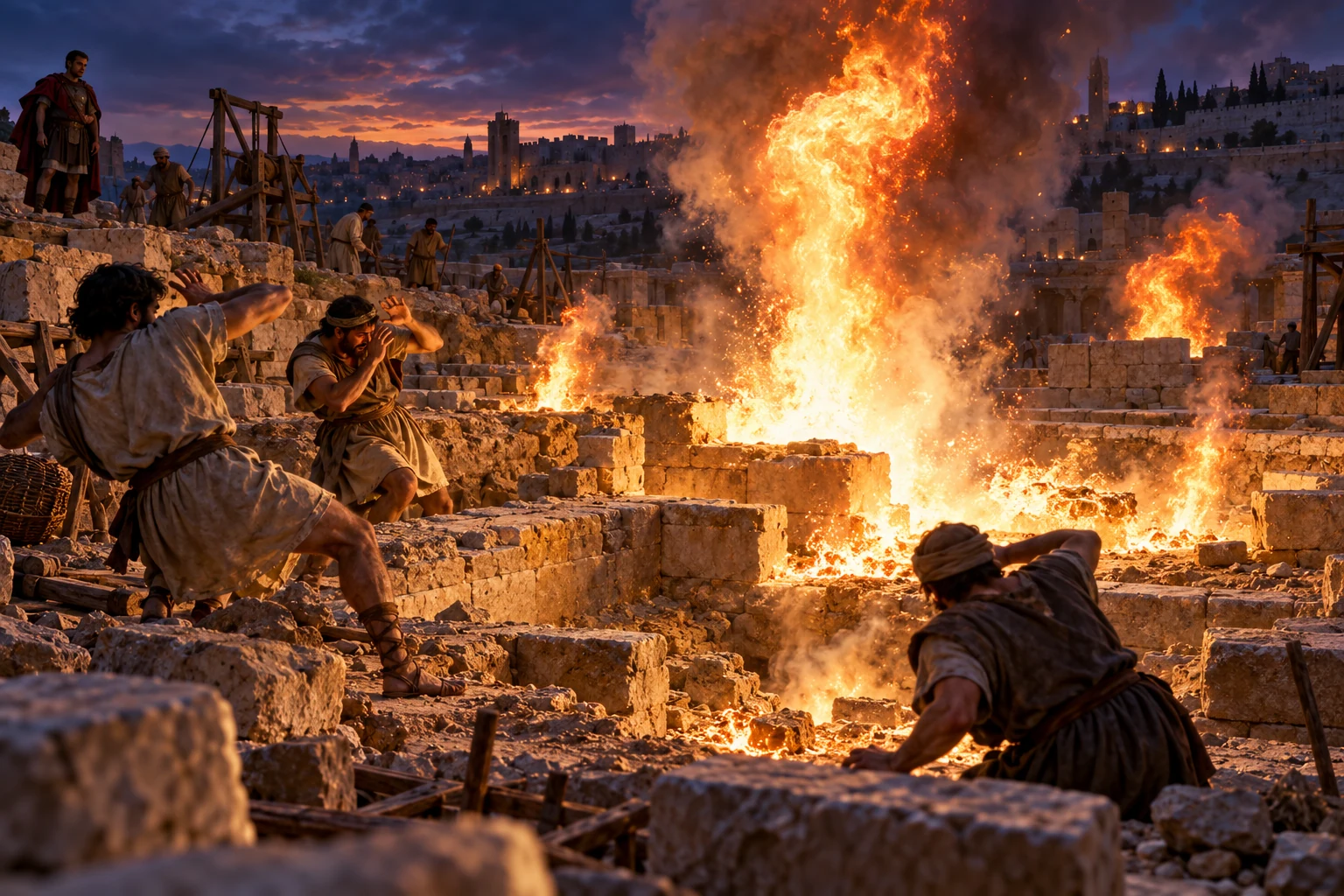
Read the historical accounts separately
Ammianus Marcellinus, Res Gestae 23.1.2–3 (J. C. Rolfe translation, 1940; LacusCurtius); Gregory of Nazianzus, Oration 5.3–4 (C. W. King translation, 1888). Both wrote after the event. Their reports are not identical, and neither excerpt establishes a modern physical explanation.
Ammianus · imperial plan and obstructing fire ↗
Gregory · divine intervention and signs ↗
Ammianus and Gregory report events from different perspectives; neither account is treated as a recording of every moment. This feature preserves the Christian supernatural interpretation without presenting all reported signs as details shared by every source.
Continue into the native geography explorer ↓ · Explore the native chronology →
Biblical Intelligence OS + Time & Calendar OS
Biblical Atlas & Timelines
Explore places, journeys, events, chronology, knowledge relationships, and calendar layers without losing the connected Scripture and evidence.Helpful Saints Biblical Atlas 2.0
Walk through place, time, calendar, and connected Scripture.
Coordinate-grounded geography, sourced journey relationships, evidence-labeled chronology, the live Zadok calendar, and the Biblical Knowledge Graph remain integrated without inventing uncertain boundaries or routes.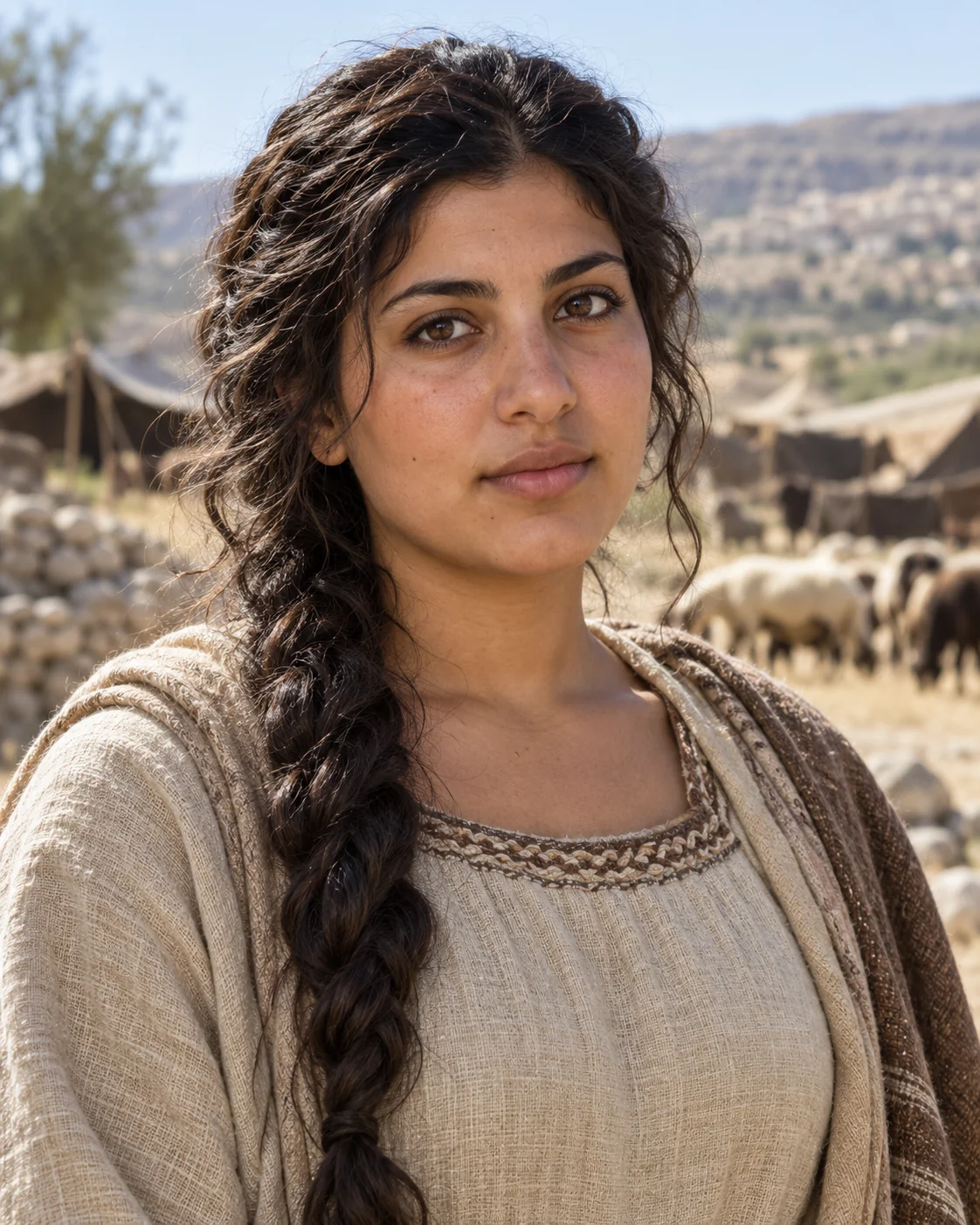
Dinah — researched portrait
Jacob-family narrative near Shechem, illustrative second-millennium BCE pastoral Levant setting; precise date and age not established. Portrait age approximately 19, artistic.- Setting
- Not established
- Culture
- Under research
- Research state
- Researching
Artistic reconstruction linked to person:dinah. Identity, biography and life chronology remain owned by the existing Biblical People registry.
AN INVITATION TO LOOK CLOSER
Enter the scene.
Question the details.
This is an artistic research reconstruction, not a photograph of the past. Explore what the sources describe, what was inferred, and what remains unknown.
THE RESEARCH DESK
Wonder. Then examine.
Dinah — researched portrait · retained profile 1RESEARCH NOTEBOOK
World context
Time, place and the paths back to primary text.
THE HISTORICAL SETTING
Jacob-family narrative near Shechem, illustrative second-millennium BCE pastoral Levant setting; precise date and age not established. Portrait age approximately 19, artistic.
Read the period boundaries
Jacob-family narrative near Shechem, illustrative second-millennium BCE pastoral Levant setting; precise date and age not established. Portrait age approximately 19, artistic.
This is the setting recorded in retained research profile 1. It is not a precise date or a second visual period. Each future period must have its own sources, claims and governed view.
CONNECTED RESEARCH
From a claim to the primary text.
These paths follow stored relationships. Open a claim to inspect its limits, or read the exact source in context.
How these connections are governed
Stored relationships, not independent historical verification. Historical context is a retained profile, not an invented global period ID or exact date. No people, events or archaeological findings are added merely because they seem related. Reader access is checked separately from a citation’s existence.
2 nodes · 1 stored relationships in this bounded view.
RESEARCH NOTEBOOK
The research question
Start with the subject, then inspect the decisions behind its presentation.
Overview
Artistic reconstruction linked to person:dinah. Identity, biography and life chronology remain owned by the existing Biblical People registry.
Historical setting
Jacob-family narrative near Shechem, illustrative second-millennium BCE pastoral Levant setting; precise date and age not established. Portrait age approximately 19, artistic.
RESEARCH NOTEBOOK
Text & evidence
What the sources constrain—and what they cannot settle.
Textual basis
Genesis 30:21; 34:1–4
RESEARCH NOTEBOOK
Materials & making
Reconstruction decisions, not recovered construction specifications.
Clothing and people
Distinct youthful adult round face with broad cheeks, medium olive skin and faint natural freckles, dark brown eyes, small rounded nose, dark coarse wavy hair in one loose braid with flyaway strands. Calm thoughtful expression. Opaque undyed wool dress with simple woven neckline and soft beige-brown shoulder cloth. Ordinary daylight portrait near an anonymous pastoral encampment, no distress reenactment, no sexualization, no modern head jewelry.
RESEARCH NOTEBOOK
What remains uncertain
The limits are part of the research, not a footnote to hide.
Uncertainties
Leah and Jacob are named parents; nineteen is an explicit adult artistic choice, not a claimed age from the text. No later painting treated as likeness evidence.
No verified face survives. Visual age, precise colors, garment cut and anonymous background are reconstructed. Regional analogies do not establish identity or an exact chronology.
RESEARCH NOTEBOOK
How this was made
Inspect the retained profile, creative decisions and asset provenance.
Visual objective
Individual photorealistic upper-torso portrait
Style target
Natural skin texture, realistic textiles and restrained daylight
Asset provenance record
- Asset identity
- Dinah portrait · version 1 · 3e3974b5-a0e1-453e-a8bf-18729e5f7292
- Creation method
- Ai Generated
- Credit
- Helpful Saints · OpenAI image generation
- Generation lineage
- OpenAI built-in image generation · Not exposed by the built-in tool
- Generated
- 2026-10-15
- Rights basis
- Authorized Ai Generation · Cleared
- Use / license statement
- Owner-authorized project use of generated assets
- Attribution
- Credit Helpful Saints and disclose artistic reconstruction. Do not describe this as a verified likeness.
- Managed file
- dinah-portrait-1122.webp · image/webp · 1122×1402 · 268 KB
- Reconstruction profile
- 01beb9cc-872e-4a05-93d4-a2e781550c82 · version 1
- Review / publication
- Approved / Public
- Certainty boundary
- Textual context and selected traits have sources; the face, exact skin tone and many costume details are reconstructed.
- Public disclosure
- Historically informed AI-generated artistic reconstruction. No verified likeness survives. Sources, disputed dates and artistic choices are recorded in the research profile.
- Source SHA-256
- c5f47d21ac44d19f33ed7985de6b418e0bfff6511e7cf39a7758744015a639c6
The research profile records editorial decisions. It is not itself primary-source evidence or a historical approval.
THE SOURCE LIBRARY
Read what stands behind the scene.
Primary text, interpretation and artistic decisions are different kinds of evidence.How to read the evidence
These are qualitative research categories, not numerical accuracy scores. A textual description supports what a source says; it does not certify every visible reconstruction choice.
Genesis 30:21
Genesis 30:21Open governed source (new tab)Primary Scripture · citation & limits
The textual witness; a description is not a complete visual specification.
Passage connection and episode context; not proof of the invented face.
Genesis 30:21; 34:1–4 (KJV)
Open governed source (new tab)Primary Scripture · citation & limits
The textual witness; a description is not a complete visual specification.
Primary biblical narrative read for identity, place and stated traits; not a verified facial likeness.
Foreigners at Beni Hassan: Evidence from the Tomb of Khnumhotep I (No. 14)
Open governed source (new tab)Bibliography / scholarship · citation & limits
A scholarly source must be evaluated for the specific claim; a citation is not automatic consensus.
Bulletin of the American Schools of Oriental Research (2020)
Middle Kingdom foreign herders/warriors' garments, pattern bands, hair and beards; regional analogy with representational biases, not patriarch identification.
No matching source is linked to this subject. Clear the filters to see the full research record.
CONTINUE THE INQUIRY
Take your next question to the sources.
Interactive Biblical Geography
Coordinate-grounded places and sourced route relationships.
This is a longitude-and-latitude place explorer—not an invented historical boundary map. Route lines show selected textual relationships and do not assert uncertain paths.Scroll the plot sideways to explore. Use Select a place or Browse places for direct navigation.
Browse places without the map
- JerusalemJudea · 2 Samuel 5; Gospels; Acts
- BethlehemJudea · Micah 5:2; Matthew 2; Luke 2
- NazarethGalilee · Matthew 2:23; Luke 1–4
- CapernaumGalilee · Matthew 4; Mark 1–2
- Caesarea PhilippiNorthern Galilee · Matthew 16; Mark 8
- DamascusSyria · Acts 9
- Antioch on the OrontesSyria · Acts 11–15
- TarsusCilicia · Acts 9:11; 21:39
- EphesusAsia Minor · Acts 18–20; Ephesians
- CorinthAchaia · Acts 18; 1–2 Corinthians
- PhilippiMacedonia · Acts 16; Philippians
- RomeItaly · Acts 28; Romans
Map integrity: no coastlines, territorial boundaries, archaeological certainty, or disputed route geometry are fabricated.
Scripture Timeline Explorer
Sequence, historical range, model, and undated hope remain distinct.
Filter eras, inspect events, open references, and send a chronology question to Scripture AI. Approximate ranges are labeled rather than presented as exact biblical dates.HELPFUL SAINTS · ZADOK CALENDAR
An ancient sacred calendar.
A living instrument from the future.
Explore the governed 364-day framework, inspect sacred dates, compare the reconstruction model, and follow every claim back to its evidence.
The next appointed moments, already in view.
Select any event to move the living instrument to that governed date and inspect its evidence.
Understand every ring. Follow every claim.
The interface separates manuscript-grounded structure from Helpful Saints’ clearly labeled modern compatibility reconstruction.
364 days
Four 91-day seasons form 52 complete weeks. The weekday pattern therefore remains stable within the governed model.
Wednesday opening
The research model begins the year on the fourth day, following the calendrical interpretation preserved in the Qumran evidence.
Twelve month sectors
The month ring makes sacred dates immediately inspectable while preserving the actual calculation engine underneath.
Feasts & Tekufot
Markers open the selected date, supporting Scripture, classification, and evidence notes without changing the calendar mathematics.
5951 AM reconstruction
AM chronology, Gregorian anchor, Jubilee notation, and intercalation are visibly identified as modern reconstruction choices.
Inspect the sources
Use Sources & Model or send the selected date to Scripture AI for a classified, provenance-rich study.
Sources & reconstruction modelWhat is manuscript-grounded, and what is a modern compatibility reconstruction?
Keyboard & movement controls
Biblical Knowledge Graph 2.0
Explore relationships while keeping evidence classifications visible.
Focus a node, filter evidence and entity types, inspect relationship language, and open connected Scripture or Scripture AI. A connection is not automatic proof of identity.Interactive Research Path
Always know where you are—and what comes next.
The stages are a guide rather than a rigid requirement. Move directly to the tool your evidence requires.Open the complete Live Zadok Calendar.
The full calendar retains feast, Tekufot, civil conversion, comparison, and model-disclosure space.
Open Live Zadok Calendar