Compare two characters
Select two different people from the collection or a card. Your selection stays in this browser tab while you explore.
Advanced tools & research
EXODUS · BIBLICAL PERSON
Miriam
Read the life. Inspect the connections. Follow the evidence.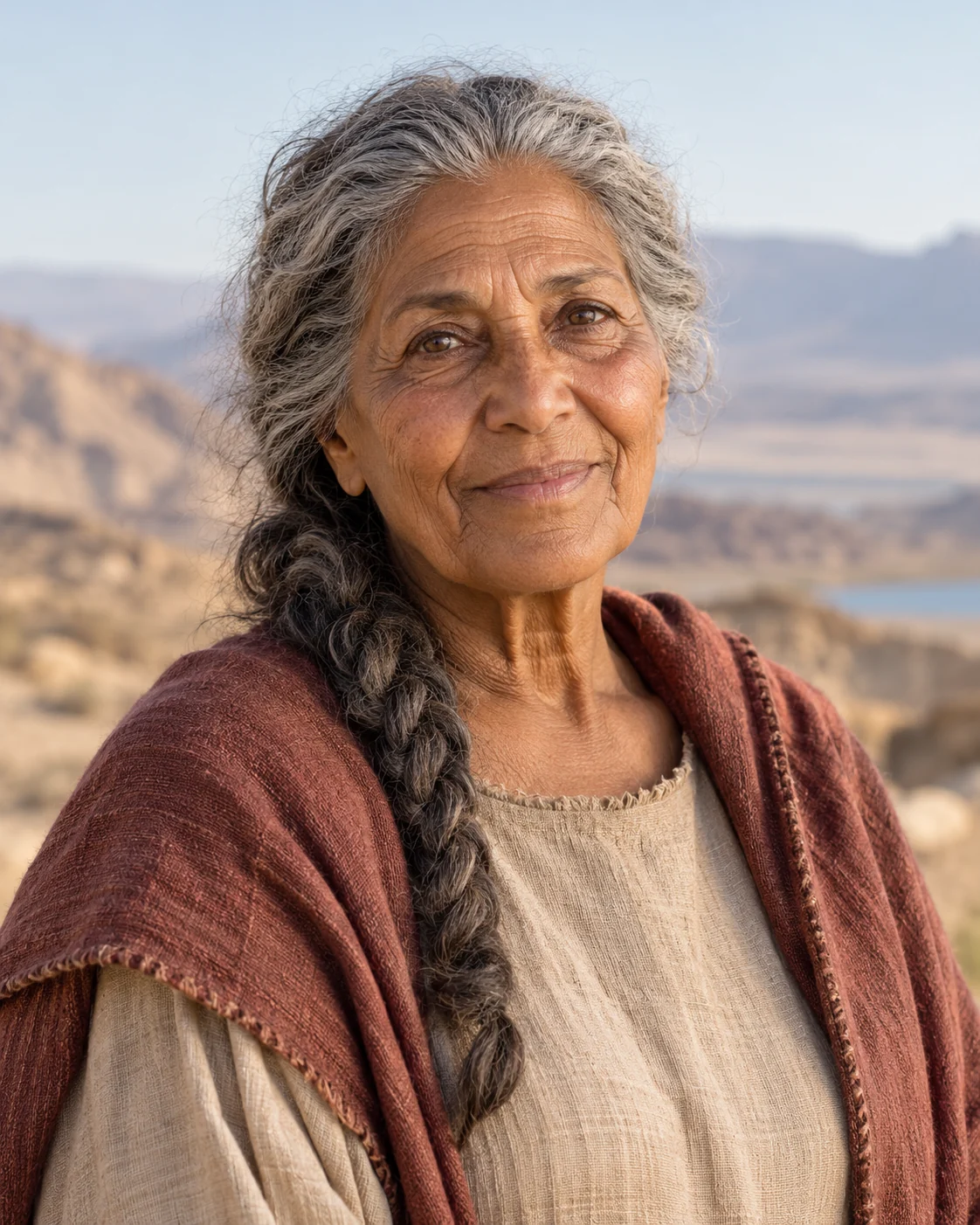
STORIES · SOURCES · DISCOVERY
Miriam
Kids experience
Discover with a grown-up
Miriam is a prophet in the Exodus story. Read her words and explore her family connections.
- NoticeWhat did you learn about Miriam?
- Read togetherAsk a grown-up to help choose a passage from the reading guide.
- WonderWhat would you like to find out from the text?
This is an imagined picture, not a verified face. A grown-up can help with difficult parts of the source texts.
Family experience
Read and wonder together
Miriam is a prophet in the Exodus story. Read her words and explore her family connections.
- Take turnsOne person reads the introduction; another chooses a cited passage.
- Talk togetherWhat does the passage tell us? Which questions does it leave open?
- Look againFind one detail in the text and one choice made by the portrait artist.
Study experience
Understand the story and its sources
Begin with the character introduction, follow the selected reading, then explore the evidence behind a statement.
- ReadOpen the passage in its own context.
- ConnectFollow a person, place, or theme without assuming an unrecorded relationship.
- ReflectRecord one supported observation and one question.
Scholar experience
Examine witnesses and interpretations
Keep the literary claim, its textual witness, later interpretation, and the artistic reconstruction distinct.
- IdentifyCheck the source title, locator, edition, and the identity of the person discussed.
- CompareRead witnesses separately before explaining an agreement or difference.
- QualifyRetain disputed identifications, unknown dates, and gaps in the surviving evidence.
4 reviewed source notes on this card. The index is selective; it does not establish exhaustive coverage.
Study experience selected. All source notes remain available.
Miriam is named as a prophetess in the Exodus story. Explore her words, family connections and wilderness setting.
Exodus · Prophetess · Leader
Try a source quest
Read Exodus 15:20–21. Which instrument and action does the text name? Which things about Miriam’s appearance remain unknown?
Open Exodus 15:20–21Read Exodus 15 in Helpful Saints
Chapter navigation in KJV with Apocrypha. The cited reading may continue across other chapters or books.
Portrait evidence & reconstruction
Exodus 15 prophetess and leader; disputed Late Bronze Age narrative setting.
Older adult woman with grey-streaked braid, undyed linen tunic and muted red-brown wool shawl; age about 85 is an artistic choice.
- Exact age and physical appearance unknown.
- Hair braid, garment cut and colors are artistic regional choices.
- No drum included; portrait is not a literal reconstruction of Exodus 15.
- Syrians Bringing Vessels and Weapons, Tomb of Rekhmire
Modern facsimile of an ancient New Kingdom scene, ca. 1479-1425 BCE; regional clothing analogy, not Moses likeness or wardrobe proof.
- Levantines in 15th and 14th Century B.C.E. Egyptian Art
Museum-linked scholarly analysis of clothing, beards and hair; Egyptian artistic conventions are biased, not photographic phenotype data.
- Bible Study Guide: Exodus
Textual narrative setting and competing early/late dating arguments; no settled historical date.
Extra-Biblical texts & document witnesses
Compare the Biblical account with later texts and manuscript traditions. A text’s description is evidence for that tradition; it does not establish a verified face or date.
- Josephus, Antiquities of the Jews2.9.4–5William Whiston translation, 1737; CCEL transcriptionAncient retelling
Miriam appears in the infant Moses narrative.
A later literary retelling; compare its wording and sequence with Scripture. It supplies no verified likeness.
Use this research card
The source list keeps the card’s evidence notes and qualifications.
The chronology and relationships below retain their registered uncertainty. Source research is continuing; this card does not claim an exhaustive bibliography.
ROLE
Prophetess · Leader
ExodusSTART / BIRTH
1,578 BCE–1,530 BCE
DISPUTEDEND / DEATH
1,450 BCE–1,405 BCE
DISPUTEDDisputed ranges
- Start / birth: disputed range registered under sacred-lives-acceptance-seed acceptance-v2: 1,578 BCE–1,530 BCE. Older sister of Moses; absolute dating disputed.
- End / death: disputed range registered under sacred-lives-acceptance-seed acceptance-v2: 1,450 BCE–1,405 BCE. Num 20:1 death at Kadesh; year follows Exodus models.
FAMILY & RELATIONSHIPS
People connected to Miriam
Each name opens that person’s page. A connection registered only on the other profile is included here and is not a new claim.
RELATIONSHIPS & EVIDENCE
Why are these lives connected?
Inspect a relationship to see its citation and what remains uncertain. A family connection does not establish an absolute date.
Immediate relationship map
Solid line: directly stated. Dashed line: unresolved, inferred, model-based or disputed; read the label. At most six immediate connections are shown.
Moses
Miriam · Sibling Of · Moses
Aaron
Miriam · Sibling Of · Aaron
LIFE AT A GLANCE
See this life in context
Miriam is 2 of 14 in Exodus, ordered by the earliest registered start year.
The timeline preserves the person’s earliest/latest bounds and shows overlap only when the registered ranges support computation.
View Miriam on the Biblical Lives Timeline Open the Exodus eraWHO LIVED AT THE SAME TIME?
Computed contemporaries
Overlap is computed from the widest registered life windows. It does not prove that two people met.
Family
Priests
Other biblical figures
How is overlap classified?
Strong requires a confidence floor of at least 65% with no approximate, modeled, or disputed boundary. Likely requires at least 45% with no disputed boundary. Other computable intersections are Possible. Unknown boundaries never assert overlap.
KEY EVENTS
Shared event identities
SCRIPTURE
Registered references
- Exodus 15:20–21Inspect ScriptureRead exact passageRead in Scripture
- Numbers 12Exact public passage unavailable hereResearch this referenceRead in Scripture
- Numbers 20:1Inspect ScriptureRead exact passageRead in Scripture
LIBRARY
Appears in
HISTORICAL / SOURCE CONTEXT
Research notes
Why are the dates shown this way?
DISPUTED / OPEN
Older sister of Moses; absolute dating disputed.
Num 20:1 death at Kadesh; year follows Exodus models.
Sources and model identity
- Scripture + traditional chronology notes · acceptance-seed
Public-domain Scripture references; chronology modeled honestly
This is a bounded name search. No Corpus work identity is inferred from the person record.
Places and Atlas
No governed place record is attached to this person in the current Sacred Lives registry. Helpful Saints does not infer a location from a name or event.
ACCEPTANCE_SEED: traditional civil ranges with explicit uncertainty; not scholarly EXACT.
THE WORDING, CLOSE AT HAND
Read the sources together
Choose one or two edition-specific excerpts. Keep each text’s own wording beside the questions it raises.
This is a selected study-excerpt collection. A linked source note may point to a longer edition, a fragment or a translation whose text has not been added here. These excerpts do not change the Scripture Library’s publication or AI evidence permissions.
Choose Read selections to open the reviewed wording. No AI question is submitted.
Highlighting compares vocabulary in these selections. It does not establish an ancient textual variant or decide which reading is correct.
THE ILLUSTRATED READING ROOM
Step into the story.
Stay close to the text.
Six authored studies. Eighteen chapters. Look carefully, listen, read the actual passage, and follow the connections.
Explore the connections atlas ↓Editorial retellings guide your study. Passage readings keep their edition labels. Every scene is AI-generated artwork with imagined faces, colors and settings.
A night to remember
A family prepares, leaves, and teaches the next generation.
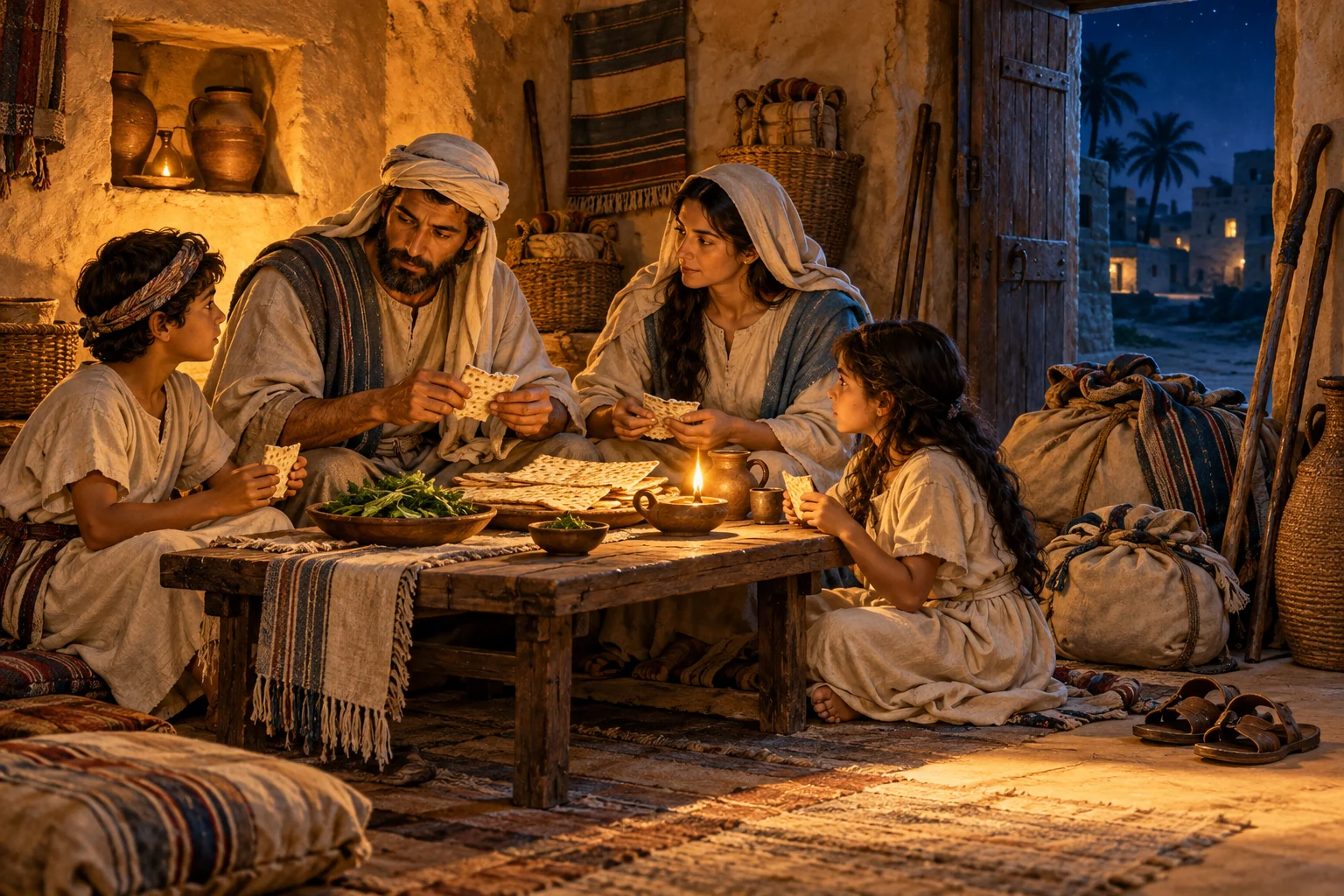
1. Bread and herbs · Text-backed objects
Exodus 12:8 names unleavened bread and bitter herbs. The picture does not show the complete prescribed meal; roasted lamb is also named.
Exodus 12:6-11 · King James Version; Project Gutenberg eBook 102. Packed bundles · Artistic choice
Bundles help suggest departure. Their shape, colors and placement are imagined; this image does not establish a historical household inventory.
Exodus 12:34-39 · King James Version; Project Gutenberg eBook 103. Travel readiness · Text and image differ
Exodus 12:11 specifies sandals on the feet and staff in hand. The seated, barefoot figures are artistic condensation, not an exact depiction of the instruction.
Exodus 12:6-11 · King James Version; Project Gutenberg eBook 10Uses your device’s available speech voice. Reading remains available without audio.
CHAPTER 1 OF 3 · EDITORIAL RETELLING
Ready at the table
Exodus describes a meal eaten with urgency. The instructions name roasted lamb, unleavened bread and bitter herbs, and call for dressed travelers with sandals and staffs. These concrete details connect remembrance to an actual departure. The picture gathers some of them into one imagined household; it does not reproduce every instruction. Notice the difference between an object named in the passage and an object that simply helps an artist tell the story. Then read the wording itself. Who receives the instructions, and what does the command to be ready add to the meal? A family discussion can begin with those observations without supplying invented dialogue or treating the painting as a ritual guide.
The family gets ready to travel. Read the list of foods and travel things with a grown-up. Which ones can you find in the picture?
Pause & consider Which details are instructions in the text, and which are artistic additions?
Exodus 12:6-11 · King James Version; Project Gutenberg eBook 10CHAPTER 2 OF 3 · EDITORIAL RETELLING
Bread for the journey
The narrative moves from preparation to departure. The people carry their dough before it is leavened, with kneading troughs wrapped in clothing. Later verses explain the unleavened cakes in terms of the urgent departure from Egypt. Read the cause and the action together rather than treating the bread as a disconnected symbol. The passage also describes a mixed multitude and livestock; a single family illustration cannot represent the whole company. Compare the objects in the account with those in the scene, and mark anything the scene leaves out. The study's retelling is a guide to observation. It does not replace the passage or establish the age, face or exact possessions of any pictured traveler.
The people carry dough and leave in a hurry. Find the verse that explains why the bread did not rise. What would you carry on a journey?
Pause & consider How does the passage explain the unleavened bread?
Exodus 12:34-39 · King James Version; Project Gutenberg eBook 10CHAPTER 3 OF 3 · EDITORIAL RETELLING
When children ask
Exodus anticipates a child's question about the service and gives the community a way to explain its remembrance. The answer turns toward deliverance and the preservation of households. This is a good place to let the child's question set the pace: read, ask, locate the answer, and allow another question. Jubilees 49 is a separate literary witness that develops Passover instructions and timing. Open its edition beside Exodus when comparing them; an added detail in Jubilees should stay attributed to Jubilees. A comparison can reveal different emphases without merging the accounts. Close by writing one sentence supported by Exodus and one question that would require more reading.
Children ask why this meal matters. Read the answer together. Tell someone one thing the passage actually says.
Pause & consider What does the explanation emphasize, and how would you keep another witness distinct?
Exodus 12:26-27 · King James Version; Project Gutenberg eBook 10Progress stays on this device when browser storage is available.
FOR CURIOUS READERS
Three ways to discover
Work together with a caregiver. These activities check observation and reading, not belief.
1. Put the story in order
Use the arrows to move each event, then check against the three chapters.
- Explain the remembrance when children ask
- Receive the meal instructions
- Carry the dough and depart
2. Look, then verify
3. Find the source
Caregiver’s source & answer guide
- Receive the meal instructions
- Carry the dough and depart
- Explain the remembrance when children ask
Bitter herbs — Exodus 12:8 names bitter herbs. Family size and cloth colors are imagined.
Source finding: Exodus 12:26–27.
Extension: draw a detail the text names, then label one choice you imagined.
From calling to song
Moses is called; Pharaoh refuses; Miriam leads a response.
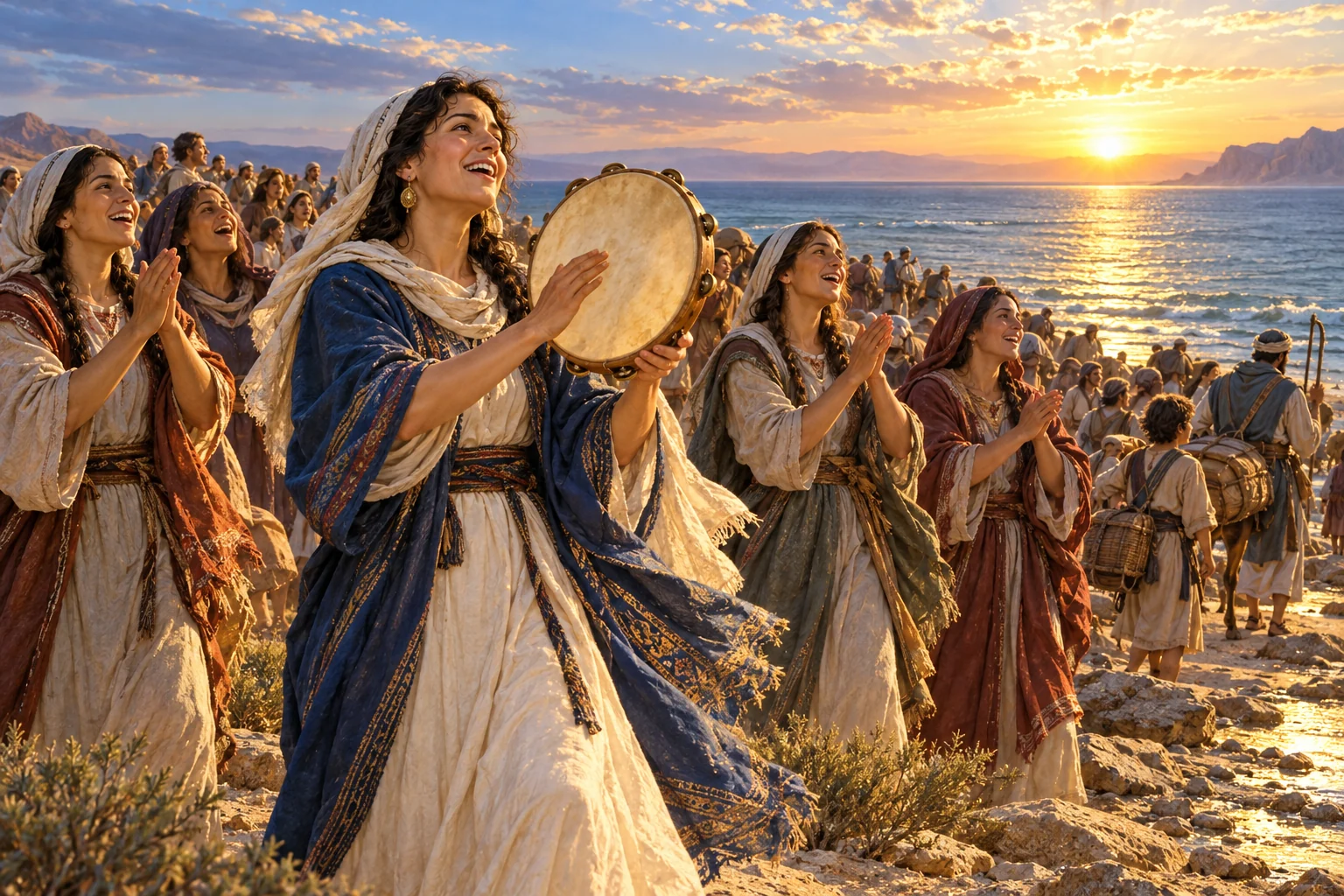
1. Miriam’s timbrel · Text-backed object
Exodus 15:20 explicitly names Miriam’s timbrel. Its exact size, material and decoration are artistic choices.
Exodus 15:20-21 · King James Version; Project Gutenberg eBook 102. Women responding · Text-backed group
The passage describes women following with timbrels and dances. It does not supply these faces or this arrangement.
Exodus 15:20-21 · King James Version; Project Gutenberg eBook 103. Sunrise and shoreline · Artistic choice
The specific terrain, time of day and colors do not come from these two verses.
Exodus 15:20-21 · King James Version; Project Gutenberg eBook 10Uses your device’s available speech voice. Reading remains available without audio.
CHAPTER 1 OF 3 · EDITORIAL RETELLING
A call in the wilderness
The account introduces Moses tending a flock before it describes the burning bush. The familiar work of a shepherd becomes the setting for an encounter that interrupts his routine. Read the sequence carefully: Moses notices, turns aside, hears his name, and is told to remove his shoes because the ground is holy. The text identifies the speaker and connects the encounter to the ancestors. It does not give the bush's species or a portrait of Moses. The shore illustration used in this study belongs to a later chapter, so it should not be treated as a picture of the calling. Keep the chapter's passage in view as you follow the larger movement from calling toward deliverance.
Moses notices something unusual and listens. This chapter happens before the shore picture. Find what he is told to do with his shoes.
Pause & consider What does Moses do before he hears the calling?
Exodus 3:1-6 · King James Version; Project Gutenberg eBook 10CHAPTER 2 OF 3 · EDITORIAL RETELLING
A demand and a refusal
Moses and Aaron address Pharaoh with a demand that Israel be allowed to hold a feast to the Lord in the wilderness. Pharaoh's response challenges the authority behind that demand and refuses to let Israel go. These brief verses establish a conflict, not its resolution. Avoid jumping straight from the first request to the later song as though nothing difficult occurs between them. The wider Exodus narrative contains the struggles that connect these moments. For this selected reading, identify who speaks, what is requested and what is refused. A careful retelling can name those three facts while acknowledging that the intervening chapters need to be read for a fuller account.
Moses and Aaron ask Pharaoh to let Israel go. Pharaoh refuses. Read who says each part; the celebration comes later.
Pause & consider How do the request and refusal frame the conflict?
Exodus 5:1-2 · King James Version; Project Gutenberg eBook 10CHAPTER 3 OF 3 · EDITORIAL RETELLING
Miriam takes the timbrel
After the crossing, Miriam is identified as a prophetess and as Aaron's sister. She takes a timbrel, and the women go out after her with timbrels and dances. Her response turns attention toward the Lord's victory. The new scene illustrates this moment through faces, landscape and morning light that the verses do not specify. The timbrel and the group of women have textual anchors; the exact shoreline does not. The song also refers to violent events, so caregivers can choose how much surrounding narrative is suitable for their children. Adults can compare the roles of Moses and Miriam in the chapter while preserving the names and titles the passage actually supplies.
Miriam takes a timbrel and the women follow her. Read the song with a grown-up. Which musical object is named?
Pause & consider Which details in the song scene are stated, and which remain unknown?
Exodus 15:20-21 · King James Version; Project Gutenberg eBook 10Progress stays on this device when browser storage is available.
FOR CURIOUS READERS
Three ways to discover
Work together with a caregiver. These activities check observation and reading, not belief.
1. Put the story in order
Use the arrows to move each event, then check against the three chapters.
- Miriam leads women with timbrels
- Moses encounters the calling at the bush
- Moses and Aaron speak to Pharaoh
2. Look, then verify
3. Find the source
Caregiver’s source & answer guide
- Moses encounters the calling at the bush
- Moses and Aaron speak to Pharaoh
- Miriam leads women with timbrels
A timbrel — The timbrel is named; the pictured instrument’s design is imagined.
Source finding: Exodus 15:20–21.
Extension: draw a detail the text names, then label one choice you imagined.
Loyalty in the barley fields
Ruth commits, gleans, and becomes part of a public family story.
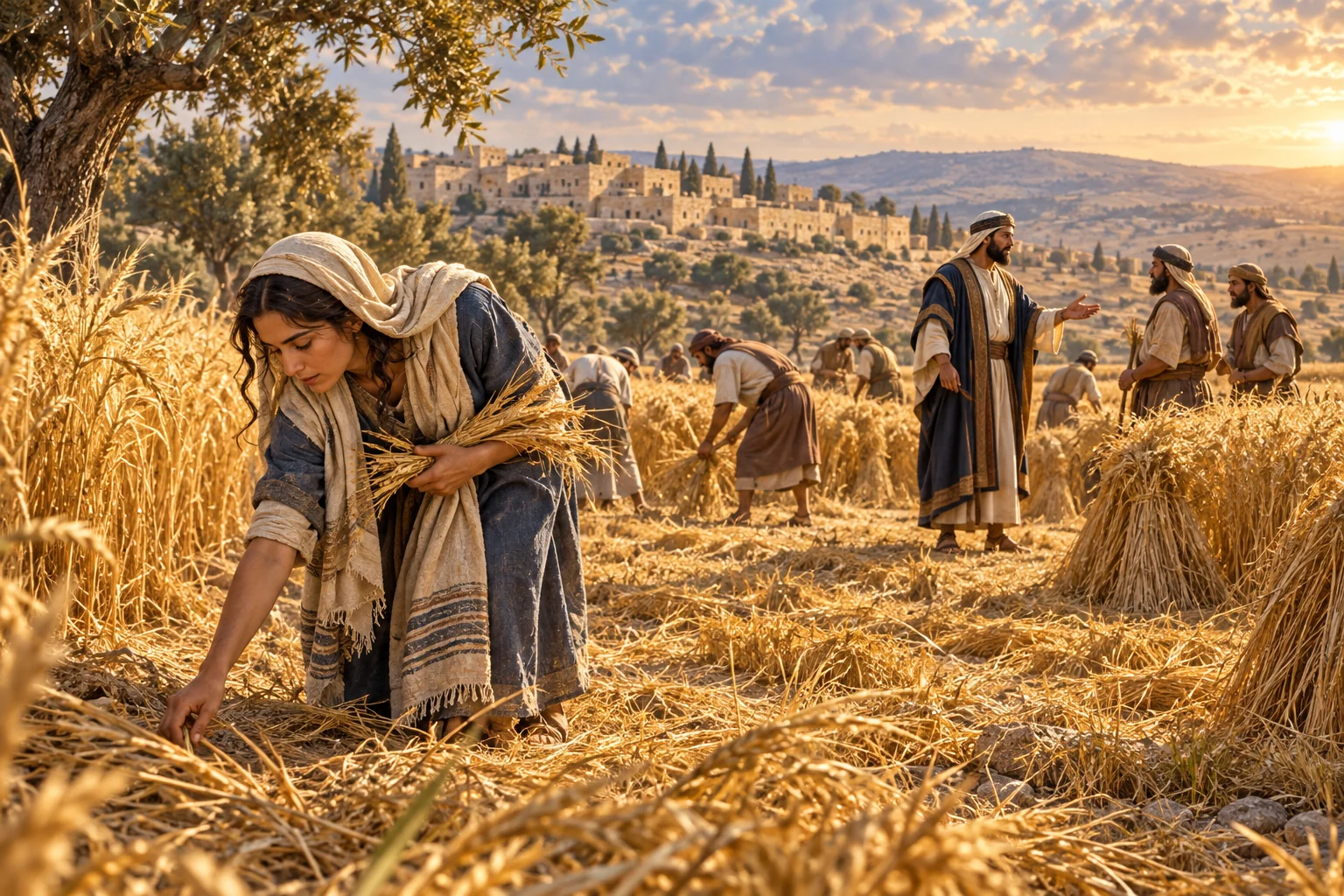
1. Gleaning · Text-backed action
Ruth 2 records gleaning. The exact posture, face and clothing are imagined.
Ruth 2:8-12 · King James Version; Project Gutenberg eBook 102. Boaz and workers · Text-backed roles
Boaz addresses Ruth and gives instructions to the workers. The image does not establish who stood in each position.
Ruth 2:8-12 · King James Version; Project Gutenberg eBook 103. Bethlehem landscape · Artistic reconstruction
The village, skyline and field layout are imagined, not an excavated view. The grain depiction is stylized.
Ruth 1:16-19 · King James Version; Project Gutenberg eBook 10Uses your device’s available speech voice. Reading remains available without audio.
CHAPTER 1 OF 3 · EDITORIAL RETELLING
A choice to remain
Ruth's response to Naomi brings a journey and a relationship into focus. She speaks of going where Naomi goes, lodging where she lodges, and joining her people and her God. Read the commitment in its setting rather than reducing it to a decorative quotation. The women continue until they reach Bethlehem, where their arrival draws attention. The text gives Ruth words to speak; the study does not invent additional conversations. Notice how the passage links belonging with action. The field illustration belongs to the next stage of the narrative, not to this conversation on the road. Keeping those settings separate helps readers follow the movement of the story.
Ruth chooses to stay with Naomi. They go to Bethlehem. Listen for the promises Ruth makes, then tell one in your own words.
Pause & consider How is Ruth’s commitment expressed through places and relationships?
Ruth 1:16-19 · King James Version; Project Gutenberg eBook 10CHAPTER 2 OF 3 · EDITORIAL RETELLING
Room to gather
In the field, Boaz tells Ruth where to glean and speaks about protection and water. Ruth asks why she has found favor when she is a foreigner. Boaz's reply connects his response to what he has heard about her care for Naomi and her departure from her own family and land. The passage offers concrete actions to examine alongside its language of refuge. Look for what Ruth may do, what the workers have been told, and what Boaz says he knows. The painting imagines the field and the people. Its grain is stylized; the exact appearance of the stalks should not be used to identify an ancient crop variety.
Boaz makes room for Ruth to gather grain and get water. Find one way he tells the workers to treat her. Why is she surprised?
Pause & consider What practical protections and provisions are named?
Ruth 2:8-12 · King James Version; Project Gutenberg eBook 10CHAPTER 3 OF 3 · EDITORIAL RETELLING
Witnesses at the gate
The selected scene at the gate explains a custom involving a shoe and then records a public declaration before elders and other people. Boaz names the family property and his marriage to Ruth within the account's concern for preserving a name. This is a legal and family setting in an ancient narrative; it should not be turned into an instruction for modern transactions without further study. Read who is named and who serves as witness. Compare this public moment with Ruth's earlier personal commitment. The three chapters trace different kinds of belonging: a chosen relationship, care in a field, and a declaration made before a community.
People at the gate hear a public promise. Find the object used in the custom and the people asked to be witnesses.
Pause & consider How does a public witness differ from a private promise?
Ruth 4:7-10 · King James Version; Project Gutenberg eBook 10Progress stays on this device when browser storage is available.
FOR CURIOUS READERS
Three ways to discover
Work together with a caregiver. These activities check observation and reading, not belief.
1. Put the story in order
Use the arrows to move each event, then check against the three chapters.
- Boaz makes a declaration before witnesses
- Ruth chooses to remain with Naomi
- Ruth gathers grain in Boaz’s field
2. Look, then verify
3. Find the source
Caregiver’s source & answer guide
- Ruth chooses to remain with Naomi
- Ruth gathers grain in Boaz’s field
- Boaz makes a declaration before witnesses
Water from the vessels — The passage tells Ruth she may drink from the water drawn by the young men.
Source finding: Ruth 4:7–10.
Extension: draw a detail the text names, then label one choice you imagined.
Five stones, a larger question
Read the challenger, the preparation, and David’s stated confidence.
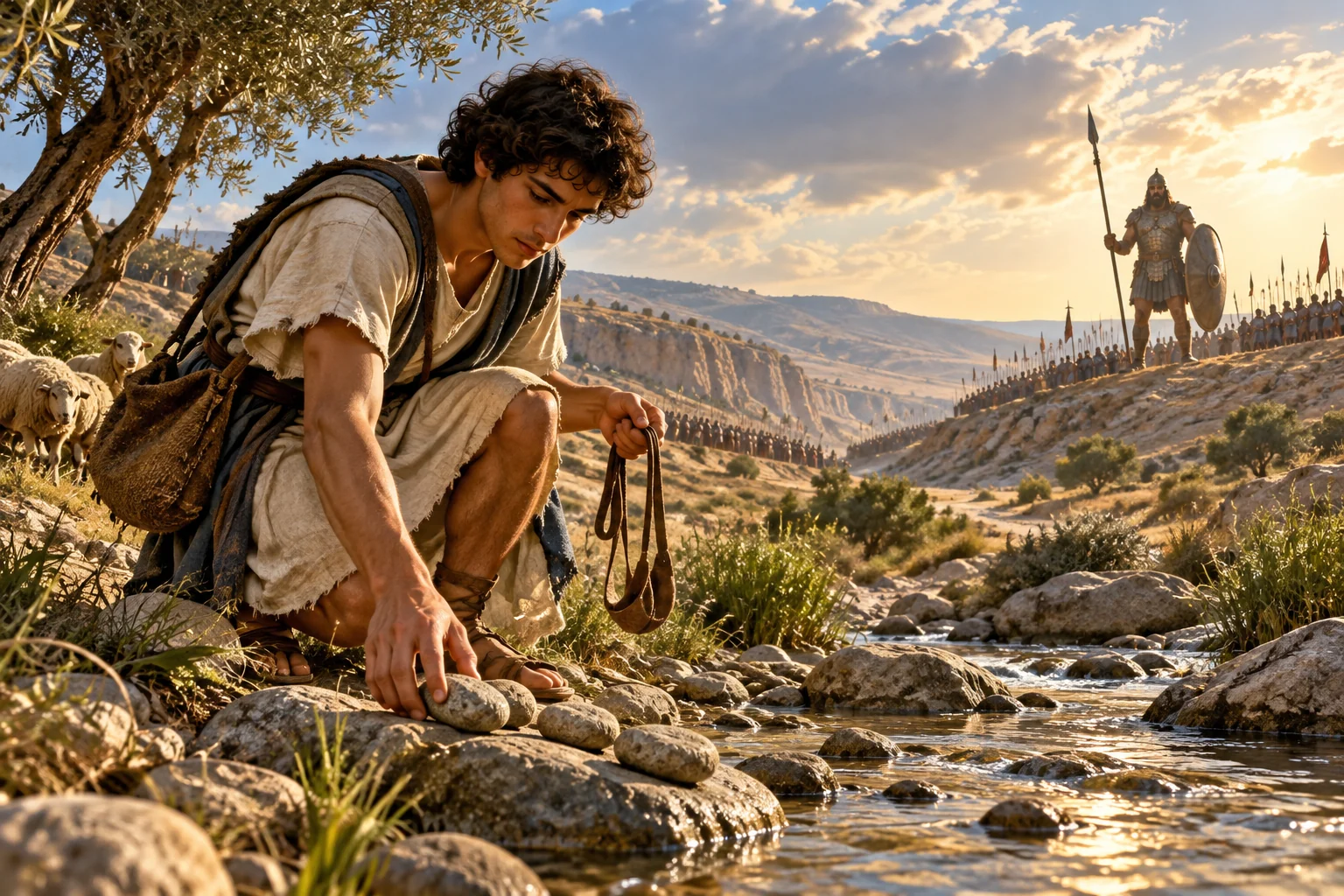
1. Stones at the brook · Text-backed detail
1 Samuel 17:40 specifies five smooth stones. Visible stones elsewhere in the scene are scenery, not a second textual count.
1 Samuel 17:38-40 · King James Version; Project Gutenberg eBook 102. Sling and bag · Text-backed equipment
The passage names a sling and shepherd’s bag. Their exact construction and David’s appearance are imagined.
1 Samuel 17:38-40 · King James Version; Project Gutenberg eBook 103. Distant Goliath · Artistic scale
The composition emphasizes contrast. Perspective and painted scale do not establish a height reading or an exact battlefield view.
1 Samuel 17:4-7 · King James Version; Project Gutenberg eBook 10Uses your device’s available speech voice. Reading remains available without audio.
CHAPTER 1 OF 3 · EDITORIAL RETELLING
An imposing challenger
The narrative introduces Goliath from Gath and describes his height, armor and weapons. The detail creates an imposing portrait before David's preparation is described. These selected verses follow the King James Version's wording. Other ancient textual witnesses preserve a different height reading, so the painting's scale cannot settle that textual question. An English illustration also cannot establish exact equipment dimensions or facial features. Read the list of equipment and distinguish what is carried from what is worn. This close observation lets the contrast with David's later choices emerge from the account itself. The study keeps the violent outcome outside the illustrated scene so families can choose how to approach the surrounding chapter.
Goliath is described with armor and weapons. Read a suitable part with a grown-up. The picture cannot tell us his exact appearance.
Pause & consider What does the equipment list contribute to the narrative?
1 Samuel 17:4-7 · King James Version; Project Gutenberg eBook 10CHAPTER 2 OF 3 · EDITORIAL RETELLING
Equipment David has tested
Saul clothes David with armor, but David removes it because he has not proved it. He then takes his staff, chooses five smooth stones from the brook, places them in a shepherd's bag, and carries his sling. The passage supplies a sequence of choices rather than a lesson that preparation never matters. Watch how unfamiliar equipment gives way to familiar tools. Our scene combines the brook with a distant view of the challenger; the exact viewpoint is an artistic construction. The stones and sling are the most direct visual anchors. Count the number the text names, and ask why a specific practical detail might be preserved in a story about trust.
David takes off equipment he has not tested. He chooses five smooth stones and carries a sling. Find the number in the passage.
Pause & consider Why does David give back the armor, and what does he choose instead?
1 Samuel 17:38-40 · King James Version; Project Gutenberg eBook 10CHAPTER 3 OF 3 · EDITORIAL RETELLING
What David says the battle means
David answers the challenge by contrasting weapons with the name of the Lord. He states that the gathered people will know that the Lord does not save by sword and spear. Read this as David's speech within the narrative and locate the words that support any summary you make. A devotional application may grow from the passage, but it should stay distinct from the quotation and from the particular conflict being narrated. The story's conclusion involves violence; caregivers should decide how to read the rest of the chapter. For this study, compare Goliath's equipment list, David's chosen tools and the confidence David explicitly expresses.
David says his confidence is in the Lord. Read his words with a grown-up and find the part about sword and spear.
Pause & consider How would you separate David’s stated claim from your own application?
1 Samuel 17:45-47 · King James Version; Project Gutenberg eBook 10Progress stays on this device when browser storage is available.
FOR CURIOUS READERS
Three ways to discover
Work together with a caregiver. These activities check observation and reading, not belief.
1. Put the story in order
Use the arrows to move each event, then check against the three chapters.
- David states his confidence before the encounter
- Read Goliath’s equipment description
- David removes unfamiliar armor and chooses stones
2. Look, then verify
3. Find the source
Caregiver’s source & answer guide
- Read Goliath’s equipment description
- David removes unfamiliar armor and chooses stones
- David states his confidence before the encounter
Five — 1 Samuel 17:40 names five smooth stones.
Source finding: 1 Samuel 17:45–47.
Extension: draw a detail the text names, then label one choice you imagined.
Courage before the throne
A message, an approach, and a remembered deliverance.
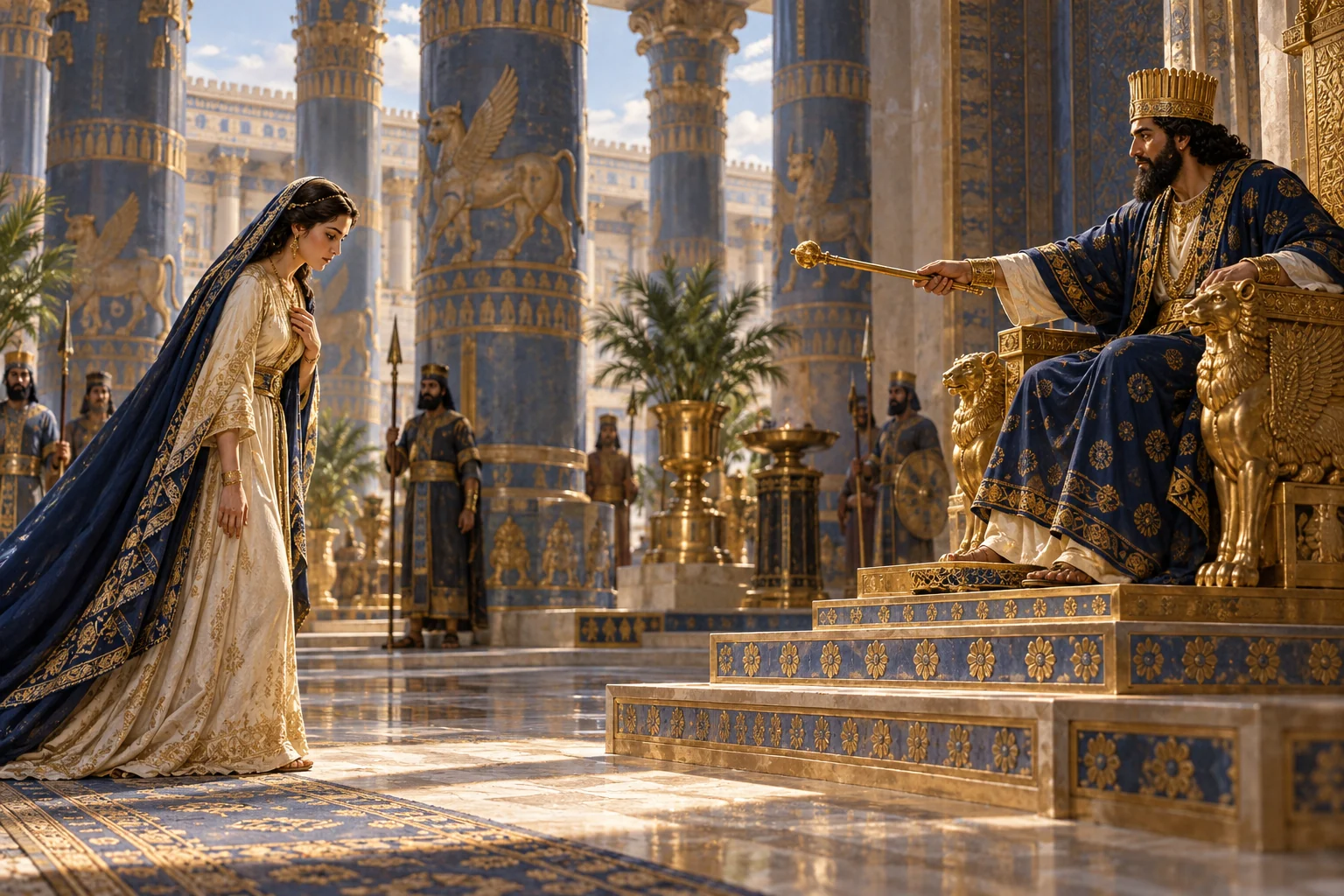
1. Golden scepter · Text-backed object
Esther 5:2 names the golden scepter and her touch. The exact design and distance are imagined.
Esther 5:1-4 · King James Version; Project Gutenberg eBook 102. Esther’s apparel · Text plus artistic choice
The passage says royal apparel; this garment’s cut, embroidery and colors are not specified.
Esther 5:1-4 · King James Version; Project Gutenberg eBook 103. Persian court · Artistic reconstruction
The scene is inspired by a Persian court, not a verified reconstruction of this exact room.
Esther 5:1-4 · King James Version; Project Gutenberg eBook 10Uses your device’s available speech voice. Reading remains available without audio.
CHAPTER 1 OF 3 · EDITORIAL RETELLING
A decision with a cost
Mordecai's message warns Esther that her place in the royal household will not necessarily protect her. He also raises the possibility that her position has meaning for this crisis. Esther responds by requesting a fast and setting out her intention to approach the king despite the danger. Read the conditional language and the decision together. The narrative gives a serious situation, not a promise that every courageous action will have an easy outcome. A family can discuss asking others for support before taking a difficult step. The study does not invent Esther's private thoughts or use an imagined face as evidence of her emotions. Begin with her recorded words and actions.
Esther asks others to fast with her before she approaches the king. Read with a grown-up and find how she asks for help.
Pause & consider What support does Esther request before acting?
Esther 4:13-16 · King James Version; Project Gutenberg eBook 10CHAPTER 2 OF 3 · EDITORIAL RETELLING
The extended scepter
Esther stands in the inner court and the king holds out the golden scepter. She approaches and touches its top. When the king asks her request, she invites him and Haman to a banquet. These selected verses unfold through several small actions; they do not immediately reveal the whole resolution. Watch the pace of the scene and identify which action permits Esther to come near. The painting draws on a Persian court setting, but its architecture, garments and seating are reconstructed artistic choices. The text's reference to royal apparel does not establish the pictured dress. Read the next chapters for the developing conflict rather than treating one image as the entire story.
The king holds out a golden scepter. Esther approaches and invites him to a meal. Find the object she touches.
Pause & consider Which action changes what Esther can do next?
Esther 5:1-4 · King James Version; Project Gutenberg eBook 10CHAPTER 3 OF 3 · EDITORIAL RETELLING
Remembering with generosity
The selected closing passage describes Mordecai recording the events and sending letters about an annual remembrance. The instructions include feasting, joy, sending portions to one another and gifts to the poor. Notice that remembrance reaches outward into care for other people. The wider chapter includes violence and difficult historical questions, so caregivers may choose these selected verses for younger readers while acknowledging the fuller account. Purim is its own commemoration in Esther's narrative; it should not silently be treated as one of Leviticus 23's appointments. End by locating one practice the passage names and describing a thoughtful act of generosity in your own setting.
The remembrance includes sharing food and gifts for the poor. Find one way the celebration helps someone else.
Pause & consider How do giving and remembrance belong together in this passage?
Esther 9:20-22 · King James Version; Project Gutenberg eBook 10Progress stays on this device when browser storage is available.
FOR CURIOUS READERS
Three ways to discover
Work together with a caregiver. These activities check observation and reading, not belief.
1. Put the story in order
Use the arrows to move each event, then check against the three chapters.
- The community receives instructions for remembrance
- Esther requests a fast
- Esther approaches and receives the scepter
2. Look, then verify
3. Find the source
Caregiver’s source & answer guide
- Esther requests a fast
- Esther approaches and receives the scepter
- The community receives instructions for remembrance
A golden scepter — Esther 5:2 identifies the golden scepter.
Source finding: Esther 9:20–22.
Extension: draw a detail the text names, then label one choice you imagined.
A place restored for worship
Inspect the sanctuary, renew its furnishings, and remember its dedication.
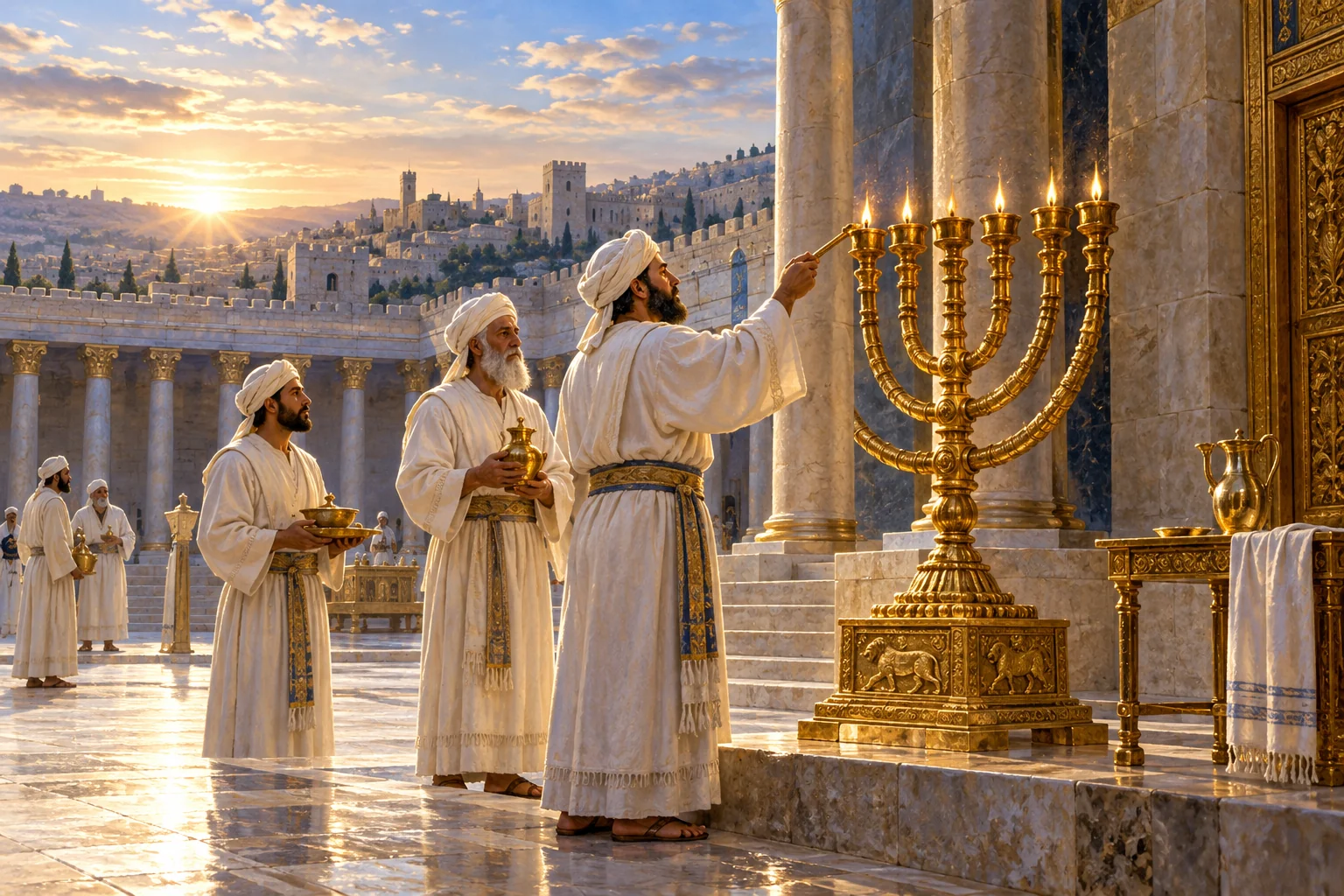
1. Lampstand · Text-backed furnishing
1 Maccabees 4:49–50 names the lampstand and lighting the lamps. The seven-branched design is an artistic reconstruction of a temple lampstand.
1 Maccabees 4:49-59 · Douay-Rheims, Challoner revision; Project Gutenberg eBook 83002. Open courtyard setting · Image and text differ
The verse says the furnishings were brought into the temple. The open setting helps show the scene but is not an exact depiction of their prescribed placement.
1 Maccabees 4:49-59 · Douay-Rheims, Challoner revision; Project Gutenberg eBook 83003. Priests and garments · Artistic reconstruction
The people, faces, garments and arrangement are imagined. The painting does not independently prove a ritual detail.
1 Maccabees 4:36-40 · Douay-Rheims, Challoner revision; Project Gutenberg eBook 8300Uses your device’s available speech voice. Reading remains available without audio.
CHAPTER 1 OF 3 · EDITORIAL RETELLING
Seeing what needs repair
In the Douay-Rheims selection from 1 Maccabees, Judas and his brothers turn toward cleansing and rededicating the sanctuary. The account describes what they find and their response to it. Read those details before jumping to the later celebration: restoration begins with looking honestly at what has been damaged. This is a distinct Second Temple narrative, not a scene from Moses' wilderness tabernacle. The broad temple view in the painting is an artistic interpretation and should not be used as an architectural plan. For younger readers, caregivers may summarize the damaged setting without dwelling on the preceding military conflict. Ask what the community chooses to do next.
The people see that the sanctuary needs care. They decide to cleanse and restore it. Read a suitable part with a grown-up.
Pause & consider What does the account describe before the work of dedication?
1 Maccabees 4:36-40 · Douay-Rheims, Challoner revision; Project Gutenberg eBook 8300CHAPTER 2 OF 3 · EDITORIAL RETELLING
New furnishings, renewed light
The passage describes making new holy vessels and bringing the lampstand, altar of incense and table into the temple. Lamps are lit, incense is offered, and bread is set on the table. These are the scene's most direct textual anchors. The illustration places the lampstand in an open architectural setting for visibility; the verse says it is brought into the temple. Its exact construction and surrounding architecture remain artistic choices. The pictured lampstand has seven branches. The later Hanukkah lamp with eight lights and a helper light belongs to a different ritual setting. Do not read a modern object or a later oil-miracle tradition into wording that does not state it.
The lamps are lit and the temple is prepared for worship. The painting shows a seven-branched lampstand. Read what the passage actually says is brought inside.
Pause & consider Which actions and furnishings does the account explicitly name?
1 Maccabees 4:49-59 · Douay-Rheims, Challoner revision; Project Gutenberg eBook 8300CHAPTER 3 OF 3 · EDITORIAL RETELLING
Eight days, and a later setting
First Maccabees 4:56–59 describes an eight-day dedication celebration and its annual remembrance. John 10:22–23 places Jesus at Jerusalem during the feast of dedication in winter and names Solomon's porch. These are connected readings from different works and settings. John's short notice does not retell the rededication, describe its whole ritual, or establish an endorsement of every later custom. Open both editions and identify the precise connection each makes. Helpful Saints maps this commemoration on its primary calendar while keeping the Hebrew comparison separate. The civil conversion is a calendar-model result, not a date supplied by the painting. Close by writing one supported statement from each witness.
One passage tells about dedication; John names a later feast of dedication in winter. Read the two separately and find what each one says.
Pause & consider What connection is explicit, and what would require another source?
John 10:22-23 · King James Version; Project Gutenberg eBook 10Progress stays on this device when browser storage is available.
FOR CURIOUS READERS
Three ways to discover
Work together with a caregiver. These activities check observation and reading, not belief.
1. Put the story in order
Use the arrows to move each event, then check against the three chapters.
- Keep the eight-day dedication remembrance
- Inspect the damaged sanctuary
- Prepare furnishings and light the lamps
2. Look, then verify
3. Find the source
Caregiver’s source & answer guide
- Inspect the damaged sanctuary
- Prepare furnishings and light the lamps
- Keep the eight-day dedication remembrance
They lit the lamps — Lighting the lamps is stated. The later oil-miracle account is not stated in this selection.
Source finding: John 10:22–23.
Extension: draw a detail the text names, then label one choice you imagined.
Read the wording
THE CONNECTIONS ATLAS
Follow a thread worth exploring.
These curated links explain their evidence type. A shared theme does not establish identity, kinship, a historical date, or a command to observe a feast.
Moses → Passover
Exodus 12 places the instructions within Moses’ leadership of the departure.
Exodus 12:6-11 · King James Version; Project Gutenberg eBook 10Passover → Unleavened Bread
Leviticus 23 distinguishes the fourteenth-day Passover appointment and the following feast.
Leviticus 23:4-8 · King James Version; Project Gutenberg eBook 10Exodus → Jubilees 49
Compare the retelling without assigning its additional instructions to Exodus.
Jubilees 49:1 · R. H. Charles, The Apocrypha and Pseudepigrapha of the Old Testament, Oxford: Clarendon Press, 1913; linked transcriptionMoses → Miriam
Both participate in the Exodus narrative; this excerpt specifically names Miriam and Aaron.
Exodus 15:20-21 · King James Version; Project Gutenberg eBook 10Calling → Passover
The call and confrontation precede the Passover instructions in Exodus.
Exodus 12:6-11 · King James Version; Project Gutenberg eBook 10Ruth → Boaz
Ruth 2 records Boaz’s provision and Ruth’s response.
Ruth 2:8-12 · King James Version; Project Gutenberg eBook 10Ruth → Naomi
Ruth’s commitment to Naomi anchors the journey.
Ruth 1:16-19 · King James Version; Project Gutenberg eBook 10Ruth → Harvest readings
A harvest narrative can be read beside harvest appointments; this does not establish an appointment date for Ruth’s field scene.
Leviticus 23:9-14 · King James Version; Project Gutenberg eBook 10David → Goliath
The chapter sets the two figures in a direct encounter.
1 Samuel 17:45-47 · King James Version; Project Gutenberg eBook 10Goliath → Og
Both are useful in a study of giant traditions; this connection does not prove kinship or equal measurements.
1 Samuel 17:4-7 · King James Version; Project Gutenberg eBook 10Goliath → Book of Giants
Compare distinct giant traditions. The thematic link is not an identification of the characters or their narratives.
1 Samuel 17:4-7 · King James Version; Project Gutenberg eBook 10Esther → Purim
Esther 9 connects the letters and annual remembrance with the narrated deliverance.
Esther 9:20-22 · King James Version; Project Gutenberg eBook 10Esther → Mordecai
Mordecai sends the warning and Esther sends her request.
Esther 4:13-16 · King James Version; Project Gutenberg eBook 10Dedication → 1 Maccabees
The selected Douay-Rheims passage describes the restored furnishings and eight-day celebration.
1 Maccabees 4:49-59 · Douay-Rheims, Challoner revision; Project Gutenberg eBook 8300Dedication → Jesus in John
John places Jesus at the feast of dedication; this short notice does not describe every custom.
John 10:22-23 · King James Version; Project Gutenberg eBook 10Dedication → Booths
Both involve multi-day celebrations. Similar duration alone does not identify them as the same observance.
Leviticus 23:33-36 · King James Version; Project Gutenberg eBook 10YOUR ZADOK COMPANION
Prepare for what is ahead.
Helpful Saints affirms the Essene/Zadok calendar as the true calendar.
Choose a native AM year, explore its observances, open preparation readings, or add an all-day calendar copy to your own calendar. Historical commemorations retain their labels.
Open the calendar companion to load verified native dates.
Gregorian dates identify daytime. Hebrew and Julian same-day labels are comparison conversions, not separate Zadok appointments. Hebrew days begin at the preceding sunset. The native engine’s civil anchor and leap-week schedule remain published model choices. Calendar downloads do not schedule emails or send notifications.
YOUR NEXT DISCOVERY
My collection & study notebook
Checking where your notebook can be saved…
Loading your notebook…
Keep notes about your study. Anyone using this signed-in account can access its notebook.
Open my saved studies
Your collection begins with one card. Save a favorite or add a study note.
A QUESTION WORTH FOLLOWING
Research workbench
Bring up to three cards together. Compare what each source says, keep its qualifications, and carry a focused question into Scripture AI.
Loading the selected public card…
These are reviewed summaries and source notes. They do not replace the full texts. Opening Scripture AI prepares a draft; it does not submit a question or establish a conclusion.
LOOK CLOSER · LISTEN · INVESTIGATE
Make the study your own
Follow a word into its dictionary, build a short listening session, or practice a careful source investigation.
Words & languages
Search the installed native Strong’s dictionaries. A dictionary entry gives possible senses; a passage and its grammar determine the sense in context. Swete’s Greek Septuagint is a translation witness with its own edition and numbering; Greek text search does not find every inflected form. The H series includes Biblical Aramaic as well as Hebrew entries.
Examples:
Choose an example or enter a word. No model is called for this dictionary search.
Investigate the language of this card’s passages in Scripture AI →
The AI link prepares a question for your review. It must identify the edition and attested language, distinguish lexical possibilities from contextual meaning, and say when the required text is unavailable.
Build a listening queue
Listen to up to three current card overviews using the existing English synthetic recordings. These readings do not reconstruct ancient pronunciation.
Preparing the current card’s recording…
Current recording transcript
A five-step source investigation
Use this method alone or read it together as a family. It is a guided study, not a score for your faith.
1 · Start with a question
Read Exodus 15:20–21. Which instrument and action does the text name? Which things about Miriam’s appearance remain unknown?
Write down what you hope the source can answer before looking for a conclusion.
2 · Identify the witness
Choose a linked source on this card. Find its title, edition or translator, locator and date. Separate an ancient text from a modern reconstruction or a picture.
- Syrians Bringing Vessels and Weapons, Tomb of Rekhmire · Material comparison
· Metropolitan Museum of Art - Levantines in 15th and 14th Century B.C.E. Egyptian Art · Research or reconstruction context
· - Bible Study Guide: Exodus · Research or reconstruction context
· American Bible Society
- Syrians Bringing Vessels and Weapons, Tomb of Rekhmire · Material comparison
3 · Read the wording in context
Open the linked edition. Read before and after the selected passage. Record what it directly says and which words are a translator’s or editor’s choice. A missing or damaged line cannot establish words that do not survive.
4 · Compare and mark the limits
A later retelling can show how a story was received. A material analogy can help an illustration. Neither automatically establishes the wording or historical accuracy of an earlier narrative.
- Exact age and physical appearance unknown.
- Hair braid, garment cut and colors are artistic regional choices.
- No drum included; portrait is not a literal reconstruction of Exodus 15.
5 · Keep a traceable finding
Record a narrow observation, its exact source and locator, and what remains uncertain. For family study, invite each person to name one thing the text says and one question it leaves open.
Your reflection stays on this page until you explicitly add and save it.
READ TOGETHER · FOLLOW A STORY · PLAY
A discovery to share
Turn a card into a family session, follow a connected reading journey, or play a game that sends you back to the sources.
A ready-to-use family session
About 15–20 minutes, with room to pause. A grown-up chooses suitable passages, reads difficult words and helps with violence, grief or other difficult parts of the sources.
Meet Miriam
Miriam is a prophet in the Exodus story. Read her words and explore her family connections.
- Notice · 2 minutes: name one thing you notice in the picture. Its details are an artist’s choices.
- Read · 6 minutes: choose a cited passage with a grown-up. Read Exodus 15:20–21. Which instrument and action does the text name? Which things about Miriam’s appearance remain unknown?
- Talk · 5 minutes: what does the text say, and what do we still wonder?
- Keep · 3 minutes: record one observation, its reference and one open question.
Open the current card’s listening tools →
The reflection stays on this page until you add it to a draft and explicitly save.
Connected reading adventures
These are reading routes through separate source accounts. A thematic connection does not mean that the people met or lived at the same time. Progress stays on this page.
Choose a route. You can open every stop’s full card and cited passage.
Play, then explain the evidence
Untimed, with explanations and another try. Read together if someone needs help. Scores stay on this page and do not measure anyone’s faith.
Who belongs to this card?
Match a reviewed introduction to its named person.
Source detective
Decide what kind of evidence you are looking at.
LOOK CAREFULLY · LEARN TOGETHER · TAKE IT HOME
Keep the discovery going
Explore three source-inspired scenes, print an activity, or take a selected reading journey offline.
Illustrated learning studio · three selected scenes
These scenes belong to their named passages. Every image is an AI-generated artistic interpretation, not a verified likeness, historical photograph or excavated view.
Print and take-home resources
For this card
Download Miriam’s activity sheet · HTML
Open the saved sheet in a browser, then print or save as PDF. It contains no account notes.
All 212 activity sheets · PDF workbook212 pages · 415 KBThe workbook follows the card collection order. Print only the pages you need.
Existing portrait study cards and collections →For families and teachers
Teacher & family facilitation guide · PDF2 pages · 45 KBReading levels, session rhythm, evidence rubric and guidance for difficult material.
Six journey packets and offline guides
Offline HTML contains reviewed notes, source quests, references and writing spaces. Linked source editions, AI, account notebooks and recordings require a connection.
Three voices in Exodus
Family packet · PDF5 pages · 50 KBOffline study guide · HTML4 KBA household story in Ruth
Family packet · PDF5 pages · 51 KBOffline study guide · HTML4 KBNames and voices in the Gospels
Family packet · PDF5 pages · 51 KBOffline study guide · HTML4 KBLetters, journeys and communities
Family packet · PDF6 pages · 53 KBOffline study guide · HTML5 KBEnoch and the giant traditions
Family packet · PDF6 pages · 53 KBOffline study guide · HTML6 KBJourneys through different books
Family packet · PDF6 pages · 53 KBOffline study guide · HTML5 KBExplore the three Temples · models, measurements & history →
THE STORY · THE WITNESSES · THE DETAILS
Explore Miriam more deeply.
Follow a statement to its source. Read different accounts in their own words, and discover the details behind the pictures.
LOOK · READ · DISCOVER
A closer look at the story
These scenes illustrate their named passages. Faces, settings and many object details are artistic choices.
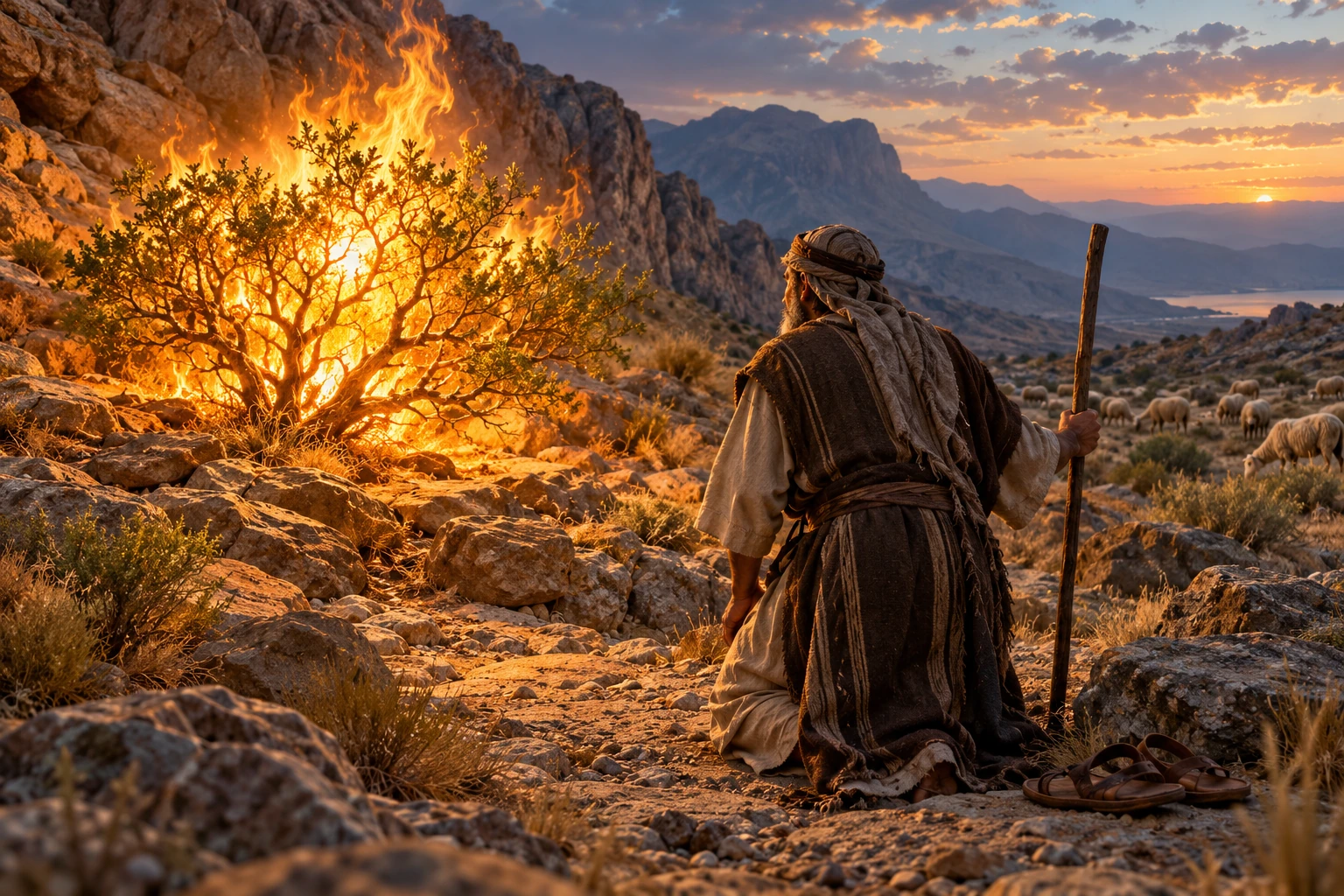
Motion is optional. The scene remains a still illustration.
A call in the wilderness
The account introduces Moses tending a flock before it describes the burning bush. The familiar work of a shepherd becomes the setting for an encounter that interrupts his routine. Read the sequence carefully: Moses notices, turns aside, hears his name, and is told to remove his shoes because the ground is holy. The text identifies the speaker and connects the encounter to the ancestors. It does not give the bush's species or a portrait of Moses. The shore illustration used in this study belongs to a later chapter, so it should not be treated as a picture of the calling. Keep the chapter's passage in view as you follow the larger movement from calling toward deliverance.
Exodus 3:1-6
Faces, colors, clothing and the precise setting are imagined. The named passage supplies the scene’s textual anchor.
Listen to the editorial study
AI-generated narration reads the editorial explanation. Cited texts retain their own wording and editions.
English name-reading helps
These are English reading choices, not claims to reconstruct ancient pronunciation: Melchizedek (mel-KIZ-uh-dek), Ezekiel (ih-ZEE-kee-uhl), Mahaway (muh-HAH-way), Qumran (KOOM-rahn), Zadok (ZAY-dok), Jubilees (JOO-bih-leez), Jasher (JASH-er). Device voices may vary.
People, places & events connected to this card
Follow the existing native cards and map entries. Read the evidence label on each connection.
Follow the sources 4 notes
These selected sources explain the card’s evidence. Coverage is selective; a missing connection is a research question.
Material comparison
Syrians Bringing Vessels and Weapons, Tomb of Rekhmire
Metropolitan Museum of Art
Modern facsimile of an ancient New Kingdom scene, ca. 1479-1425 BCE; regional clothing analogy, not Moses likeness or wardrobe proof.
Source note
Levantines in 15th and 14th Century B.C.E. Egyptian Art
Museum-linked scholarly analysis of clothing, beards and hair; Egyptian artistic conventions are biased, not photographic phenotype data.
Source note
Bible Study Guide: Exodus
American Bible Society
Textual narrative setting and competing early/late dating arguments; no settled historical date.
Textual tradition
Josephus, Antiquities of the Jews
2.9.4–5
William Whiston translation, 1737; CCEL transcription
Miriam appears in the infant Moses narrative.
Read the evidence
Compare the accounts
Place two source notes or exact readings alongside one another. A later interpretation, a manuscript record and an archaeological comparison answer different questions.
Explore manuscripts & reading editions
Open current public editions in the existing Scripture Library. Hebrew and Aramaic transcriptions retain their fragment divisions, damaged text and editorial notation.
Artifact photographs and modern editions retain their own credits and permissions. A gap in a scroll remains a gap.
Follow an authored source investigation
Take a question through different witnesses. Read the linked editions, compare a source guide, and keep a cited finding in your notebook draft.
The outline shows only the 9:4 footprint ratio from Deuteronomy 3:11. It does not reconstruct a body or prove a modern cubit length.
Listen to the editorial study
AI-generated narration reads the editorial explanation. Cited texts retain their own wording and editions.
English name-reading helps
These are English reading choices, not claims to reconstruct ancient pronunciation: Melchizedek (mel-KIZ-uh-dek), Ezekiel (ih-ZEE-kee-uhl), Mahaway (muh-HAH-way), Qumran (KOOM-rahn), Zadok (ZAY-dok), Jubilees (JOO-bih-leez), Jasher (JASH-er). Device voices may vary.
Your writing stays on this page until you add it to a draft and explicitly save.
Prepare this question in Scripture AI →The AI link prepares a public authored question for review. It does not send your reflection or submit a question. Your current card remains the notebook context.
Coverage: selected source notes and linked editions.
FOLLOW THE EVIDENCE
Study Miriam
Move from the portrait to the sources, compare their claims and follow a guided reading path.
1 · Evidence behind each statement
Each statement below is linked to its evidence note. A source can support a literary claim, a tradition or a material comparison without verifying the portrait.
Material comparisonModern facsimile of an ancient New Kingdom scene, ca. 1479-1425 BCE; regional clothing analogy, not Moses likeness or wardrobe proof.
This is a concise source note. Read the cited witness in its own edition; it does not authenticate the portrait.
Inspect the cited sourceResearch or reconstruction contextMuseum-linked scholarly analysis of clothing, beards and hair; Egyptian artistic conventions are biased, not photographic phenotype data.
This is a concise source note. Read the cited witness in its own edition; it does not authenticate the portrait.
Inspect the cited sourceResearch or reconstruction contextTextual narrative setting and competing early/late dating arguments; no settled historical date.
This is a concise source note. Read the cited witness in its own edition; it does not authenticate the portrait.
Inspect the cited sourceTextual tradition · attribution qualifiedMiriam appears in the infant Moses narrative.
A later literary retelling; compare its wording and sequence with Scripture. It supplies no verified likeness.
Inspect the cited sourceArtistic reconstructionThe portrait has no verified physical likeness. Face, apparent age, garments and setting include artistic choices.
This limits the image claim; it is not an assertion made by an ancient witness.
2 · Explore passages and sources
Search the known references and reviewed source notes on this card. This is a growing reading index, not a claim to list every occurrence.
Registered reading references
- Exodus 15:20–21
Reading selected for the card’s source quest.
Read the public edition in Helpful Saints - Numbers 12
Registered reference; edition and numbering remain qualified.
- Numbers 20:1
Registered reference; edition and numbering remain qualified.
Read the public edition in Helpful Saints
Cited witnesses and evidence notes
Syrians Bringing Vessels and Weapons, Tomb of Rekhmire
Modern facsimile of an ancient New Kingdom scene, ca. 1479-1425 BCE; regional clothing analogy, not Moses likeness or wardrobe proof.
Metropolitan Museum of ArtLevantines in 15th and 14th Century B.C.E. Egyptian Art
Museum-linked scholarly analysis of clothing, beards and hair; Egyptian artistic conventions are biased, not photographic phenotype data.
Bible Study Guide: Exodus
Textual narrative setting and competing early/late dating arguments; no settled historical date.
American Bible SocietyJosephus, Antiquities of the Jews
2.9.4–5
Miriam appears in the infant Moses narrative.
William Whiston translation, 1737; CCEL transcriptionA later literary retelling; compare its wording and sequence with Scripture. It supplies no verified likeness.
No indexed sources match. Clear the search or choose another category.
3 · Compare source witnesses
Compare two source witnesses
What does each witness contribute, and what does neither establish?
A later retelling, material analogy and textual claim answer different questions. Keep their dates, genres and qualifications separate.
These are reviewed paraphrases and evidence notes. Open the source for the original wording and its edition.
4 · Explore the connection map
Explore registered relationships and separately labeled reading connections. A shared theme does not establish a family tie or a meeting.
Sibling Of · Moses
UnresolvedThis registered connection has no attached passage evidence here. Do not treat it as established.
Citation not attached
Explore MosesSibling Of · Aaron
Directly StatedExodus 15:20 calls Miriam the sister of Aaron. This directly supports their sibling relationship. Exodus 15:20–21 is the surrounding narrative context, not additional sibling or absolute dating evidence.
Exodus 15:20
Read the public edition in Helpful SaintsExplore Aaron
5 · Story and witness timelines
The chronology of a narrated life is different from the date of a text, manuscript or modern edition. These two lanes keep them separate.
Story and registered chronology
Exodus
- Birth or beginning1578 BCE to 1530 BCEDISPUTED
Older sister of Moses; absolute dating disputed.
- Death or ending1450 BCE to 1405 BCEDISPUTED
Num 20:1 death at Kadesh; year follows Exodus models.
Model dates are not independent historical proof. Unknown dates stay unknown.
Texts, witnesses and editions
- Syrians Bringing Vessels and Weapons, Tomb of RekhmireComposition or copy date not established on this card.Metropolitan Museum of Art
- Levantines in 15th and 14th Century B.C.E. Egyptian ArtComposition or copy date not established on this card.
- Bible Study Guide: ExodusComposition or copy date not established on this card.American Bible Society
- Josephus, Antiquities of the JewsComposition or copy date not established on this card.William Whiston translation, 1737; CCEL transcription
A translation or publication date is not automatically the date of the ancient work or of an event it narrates.
6 · Places in the sources
A place mentioned in a source is not automatically an exact event site. The map uses only cited reference points; unmapped and literary settings remain labeled.
No locatable places have been added to this card. Literary geography is not assigned invented coordinates.
7 · Ask about this character
Ask a question about this character. Answers use only the cited evidence notes and qualifications on this card. Your question stays in this page.
Choose a suggested question or enter your own.
8 · Guided study paths
A guided route for this card
- Read the selected passage: Read Exodus 15:20–21. Which instrument and action does the text name? Which things about Miriam’s appearance remain unknown?
- Inspect the evidence behind one statement. Separate the witness from the portrait’s artistic choices.
- Compare two sources, retaining their dates, genres and identity qualifications.
- Write one supported observation and one question that remains unresolved.
Open my saved study notebook to keep notes across visits.
Themed study paths
Giants across distinct traditions
Compare size, power and judgment without merging different characters or witnesses.
What does each source actually say about size, and where does later interpretation begin?
Four archangels and their witnesses
Compare named roles and titles across their own textual and religious witnesses.
Which source supplies each name or role, and which details belong to later reception?
Women, courage and testimony
Read different stories of faithfulness, leadership and the testing of testimony.
Who speaks, who is believed, and how does the narrative establish or challenge testimony?
Enoch and connected traditions
Keep Genesis, Enochic works and the fragmentary Book of Giants distinct.
Which connections are stated in a witness and which are only comparisons across texts?
Wisdom, interpretation and counsel
Follow different portrayals of advice, discernment and interpretation.
What makes advice trustworthy in each story, and what limits should readers retain?
Early Christian companions
Explore service and witness while distinguishing namesakes.
How do these people contribute beyond the most familiar central figures?
9 · Names and listening
Listen to the name or the card’s overview. The recording uses an English synthetic voice; it is a reading aid, not a reconstruction of ancient pronunciation.
Name reading
Overview narration
Overview transcript
Miriam. Miriam is named as a prophetess in the Exodus story. Explore her words, family connections and wilderness setting. The portrait is an artistic interpretation; appearance is unknown.
10 · Printable study cards
Download a two-sided study card with the accepted portrait, a source quest, selected references, qualifications and a QR link to the full card. Print at actual size; for duplex printers use the orientation shown in your printer preview.
Download this study card · PDF
Themed card collections
- Giants across distinct traditions · 3 cards
- Four archangels and their witnesses · 4 cards
- Women, courage and testimony · 5 cards
- Enoch and connected traditions · 4 cards
- Wisdom, interpretation and counsel · 4 cards
- Early Christian companions · 5 cards
The printable references are selected, not exhaustive. The QR link opens the full online evidence notes.